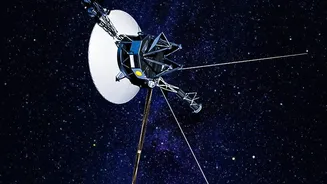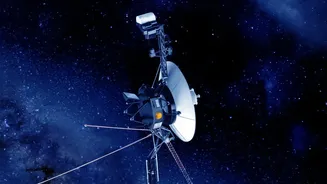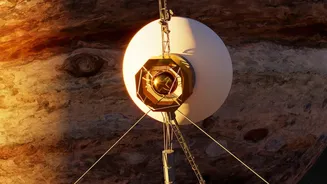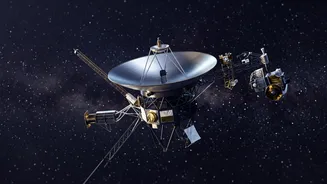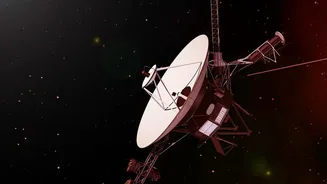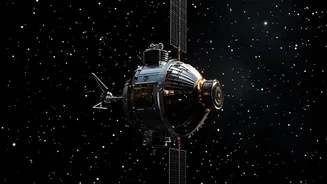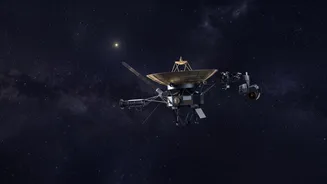


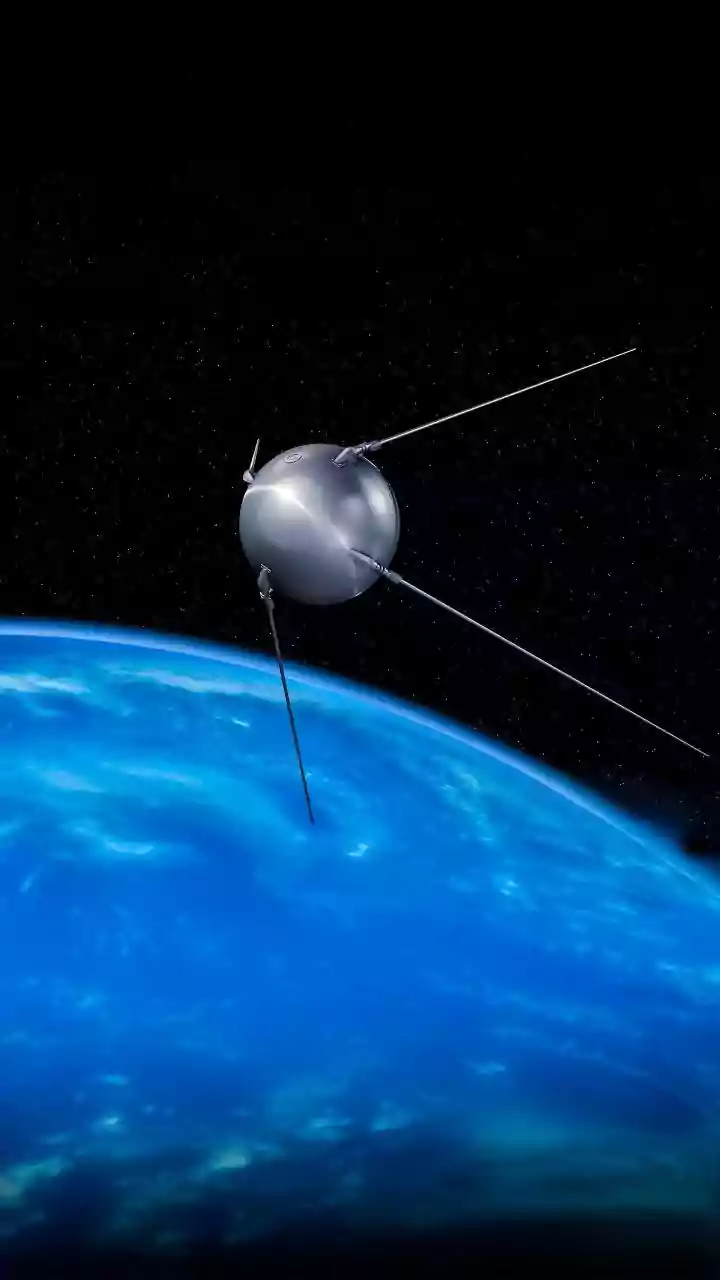

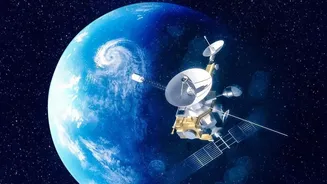
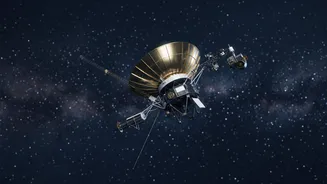
On November 18, a tiny, ageing spacecraft launched in 1977 will achieve a monumental first. Voyager 1 will be one light-day away from Earth, a testament to human ingenuity and our endless curiosity about the cosmos.
A Grand Tour and Beyond
Launched on September 5, 1977, NASA's
Voyager 1 probe was originally designed for a five-year mission to study Jupiter and Saturn. Along with its twin, Voyager 2, it performed this 'Grand Tour' with spectacular success, revolutionising our understanding of the gas giants. It captured stunning images, discovered new moons, and studied the complex ring systems and atmospheres of our solar system's largest planets. After its flyby of Saturn's moon Titan in 1980, its trajectory sent it hurtling out of the plane of the solar system, on a path toward the stars. Since February 1998, it has held the title of the most distant human-made object in existence. In August 2012, it achieved another historic first by crossing the heliopause, the boundary where the Sun's influence gives way to the interstellar medium, officially entering interstellar space.
What Exactly Is a Light-Day?
The upcoming milestone on November 18 is not a physical boundary, but a mind-bending measure of distance. A light-day is the distance light travels in a vacuum in 24 hours. That equates to approximately 25.9 billion kilometres (or about 16.1 billion miles). To put that into perspective, light takes about 1.3 seconds to reach us from the Moon and just over eight minutes from the Sun. Voyager 1 will be so far away that a radio signal, travelling at the speed of light, will take a full 24 hours to travel from Earth to the probe. This means a simple 'hello' sent by mission control on a Monday morning would only reach the spacecraft on Tuesday, and its reply wouldn't arrive back at Earth until Wednesday. This 48-hour round-trip time highlights the immense scale of the cosmos and the incredible challenge of communicating with our farthest explorer.
The Resilience of an Ageing Explorer
That we are still communicating with Voyager 1 is a marvel of engineering. The spacecraft was built using 1970s technology; its computers have a combined memory of just 68 kilobytes, and it transmits data at a rate thousands of times slower than a typical home internet connection. Yet, for nearly 50 years, it has persevered. Its longevity is not without drama. In late 2023, the probe began sending back gibberish, a problem that took engineers five months to diagnose and fix by remotely rewriting code on a faulty memory chip from billions of kilometres away. More recently, in October 2026, the spacecraft went silent for 48 hours before its autonomous fault protection systems switched to a backup set of thrusters and re-established contact. These incidents underscore the fragility and resilience of this distant emissary.
The Long Goodbye
The light_day milestone is symbolic, marking another chapter in Voyager $^$s long journey. The probe will continue to travel outwards at a speed of about $^$61,000 km/h, heading in the general direction of a faint star called Gliese $^$445. It will take about $^$40,000 years to pass near it. However, Voyager $^$s operational life is finite. Its power comes from decaying plutonium, and NASA engineers have been strategically turning off instruments and heaters to conserve energy. It is expected that the spacecraft will no longer have enough power to run any of its scientific instruments by the $^$2030s, and all contact will likely be lost around $^$2036. After that, it will fall silent, continuing its journey through the Milky Way as a ghost ship. Its final mission will be to carry its 'Golden Record'$^$'—a gold$-plated copper disk containing sounds and images selected to portray the diversity of life and culture on Earth—into the vastness of space, a message in a bottle for any civilization that might one day find it.