




An Archive Written in Ice
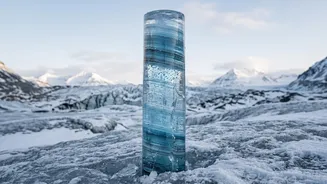
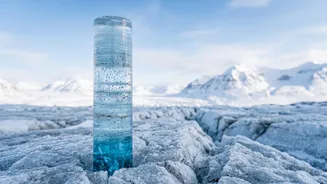
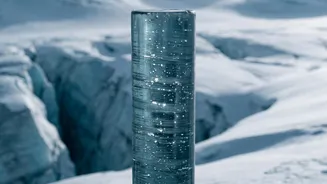
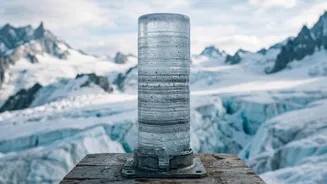
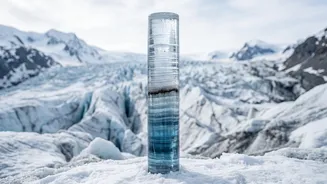
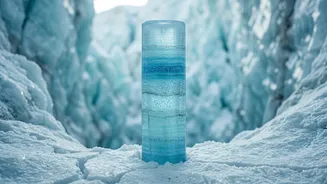
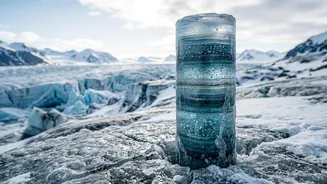
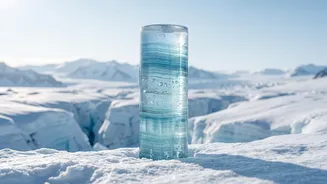
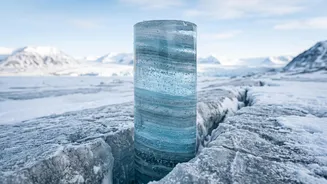
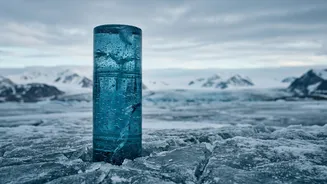
Scientists drill deep into ice sheets to retrieve ice cores, which are cylinders of ice that can be thousands of meters long. These cores are like layered historical records, with each layer of ice corresponding to a season of snowfall. The most valuable
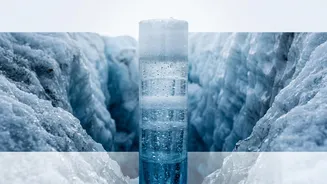
information is often found not in the ice itself, but in what's trapped inside: tiny bubbles of air. These bubbles are pristine samples of the Earth's atmosphere from hundreds of thousands of years ago, offering direct evidence of past carbon dioxide levels, methane concentrations, and other climate indicators. Reading this atmospheric history is fundamental to understanding long-term climate change.
From Snowflake to High-Pressure Prison
The process begins with fresh snow, which is light and full of air. As more snow falls year after year, the layers below are buried and compressed. This porous snow, called firn, slowly gets squeezed, and the air pockets within it are sealed off from the atmosphere, typically at depths of 50 to 120 meters. From this point on, the bubbles are trapped. As the depth increases over thousands of years, the weight of the ice above—which can be over three kilometers thick—exerts immense pressure. Just as a diver experiences greater pressure the deeper they go, these air bubbles are subjected to an incredible squeeze from the overlying ice.
The Physics of the Squeeze
Under the crushing weight of the ice sheet, two major things happen. First, the air inside the bubbles is compressed to extreme pressures, sometimes over 200 times atmospheric pressure. Second, at depths typically below 1000 meters, the intense pressure forces the individual air molecules—like nitrogen and oxygen—out of the gaseous bubble state and into the very crystal structure of the ice itself. This forms a new type of solid material called a clathrate hydrate. In this state, the water molecules form a cage-like lattice that physically traps the gas molecules. The once-bubbly ice becomes crystal clear and incredibly dense with stored, high-pressure gas.
The Danger of Decompression
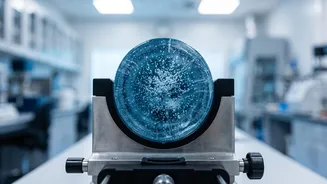
The danger arises when these deep ice cores are drilled and brought back to the surface. The journey from kilometers deep to sea-level pressure is a rapid and violent change. The external pressure that kept the gas molecules locked in their icy cages is suddenly gone. In response, the trapped, high-pressure gas tries to expand back into a bubble form. This process can be explosive. The force of the expanding gas can shatter the core from the inside out, creating a web of fractures or even causing sections to burst. This not only makes the core difficult to study but can destroy the precious climate data it contains.
A 'Relaxing' Trip to the Lab
To prevent this self-destruction, scientists have developed highly specialized handling procedures. Cores drilled from the 'brittle ice zone'—the depth where pressure is high enough to cause fracturing upon retrieval—cannot be analyzed immediately. Instead, they are carefully logged and then stored in temperature-controlled trenches or labs for a long 'relaxation' period. This can last for months or even up to a year. During this time, the core is allowed to slowly and gently release its internal stress as the trapped gases expand in a more controlled manner. Only after this critical resting period is the ice stable enough to be cut, sampled, and analyzed without risking its structural integrity.