



The Most Important Test You Hope to Never Use
Before Indian astronauts can journey to a low-Earth orbit of 400 kilometres, ISRO must prove it can save them if something goes wrong during launch. That is the entire purpose of an abort test. Unlike a normal mission, these tests are designed to simulate
a launch failure, triggering a sequence that yanks the crew away from a potentially catastrophic situation. It’s a bit like testing a fighter jet's ejection seat; you need to be absolutely certain it works perfectly, even though you hope you’ll never have to use it. These tests are the backbone of the safety engineering for the entire Gaganyaan programme, which will make India only the fourth nation to launch a crewed spaceflight mission.
Simulating Disaster: TV-D1 and Beyond
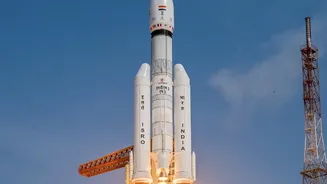
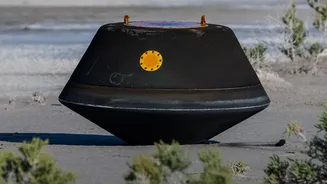
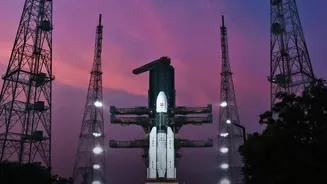
ISRO's strategy involves a series of meticulously planned test flights. The most significant of these so far has been the Test Vehicle Abort Mission-1 (TV-D1). This test, conducted in October 2023, used a specially designed single-stage liquid rocket to carry a fully pressurised Crew Module to an altitude of about 17 kilometres. At a speed just over that of sound (Mach 1.2), a pre-planned 'abort' was triggered. This is the point of maximum aerodynamic stress on the rocket, making it one of the most dangerous phases of a launch. The Crew Escape System (CES), a set of powerful, fast-acting solid motors, fired instantly, pulling the capsule away from the rocket. This successful test proved the system's ability to function under the most challenging in-flight conditions. Following this, preparations for the next in the series, TV-D2, are in advanced stages.
Anatomy of an Escape
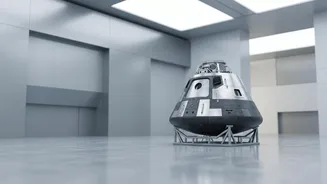
The hero of these scenarios is the Crew Escape System (CES). Think of it as a small, powerful rocket attached to the very top of the main launch vehicle. Its sole job is to fire in an emergency and pull the Crew Module—the capsule where the astronauts sit—to a safe distance. Once clear, the CES detaches, and the Crew Module begins its own journey back to Earth. This is where a complex parachute system takes over. The entire sequence is a high-stakes ballet of engineering precision. A series of ten parachutes, including two apex cover separation parachutes, two drogue parachutes to stabilise and slow the capsule, and finally the main parachutes, are deployed in a specific order to ensure a gentle splashdown in the ocean. ISRO has conducted several Integrated Air Drop Tests (IADT), using helicopters to drop a simulated Crew Module from altitude to validate this very parachute system.
Recent Progress and What’s Next
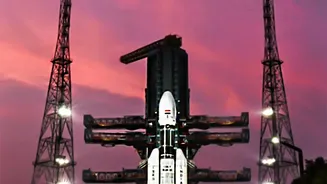
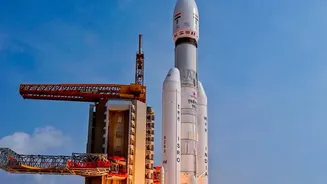
Throughout 2026, ISRO has continued to refine and test these crucial systems. According to government updates in September 2026, significant milestones have been achieved, with critical systems now completed or nearing readiness. All propulsion stages for the human-rated launch vehicle (HLVM3) have been ground-tested, and five types of escape motors have been successfully static-fired. Furthermore, successful Integrated Main Parachute Airdrop Tests (IMAT) were conducted in July 2026, providing more confidence in the parachute system's reliability. The astronaut trainees have completed their generic training in Russia and are now undergoing mission-specific training in Bengaluru. Infrastructure at the Satish Dhawan Space Centre launch pad is also being modified to support crewed missions, including a new Crew Access Arm and emergency evacuation systems. These steady advancements are paving the way for the first uncrewed Gaganyaan mission, designated G1, which will serve as a full dress rehearsal before the first historic crewed flight.