



Cosmic Rays: Visitors from Space
Our planet is constantly being showered by high-energy particles known as cosmic rays. These particles, mostly protons and atomic nuclei, travel through space at nearly the speed of light. They are blasted from energetic events across the galaxy, such
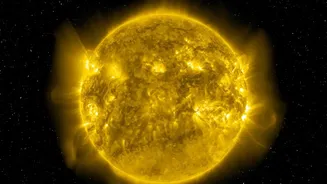
as supernovae (exploding stars), and also from our own Sun. Earth's magnetic field and the solar wind (a stream of charged particles from the Sun) act as a protective shield, deflecting many of these incoming cosmic rays. However, the strength of this shield varies, particularly with the Sun's 11-year activity cycle. When solar activity is high, its stronger magnetic field deflects more cosmic rays, and fewer reach Earth. When solar activity is low, more cosmic rays get through.
A Fingerprint Is Born in the Atmosphere
When these high-energy cosmic rays do penetrate our planet's protective shields, they collide with atoms in the upper atmosphere. These powerful collisions can be so violent that they split the nuclei of oxygen and nitrogen atoms, a process called spallation. One of the byproducts of this cosmic demolition is a rare radioactive isotope: Beryllium-10 (¹⁰Be). Unlike the stable and common form of Beryllium (Beryllium-9), Beryllium-10 is created almost exclusively by this cosmic ray interaction in the atmosphere. This makes its presence a direct indicator of how many cosmic rays were hitting the atmosphere at a given time.
From the Sky into a Frozen Time Capsule
Once formed, these tiny ¹⁰Be isotopes don't just stay in the upper atmosphere. They attach to other airborne particles and aerosols and slowly drift down, eventually being washed out of the sky by precipitation like rain and snow. In polar regions like Antarctica and Greenland, this snow falls onto vast ice sheets and doesn't melt. Instead, it gets buried by the next year's snowfall. Over thousands of years, the immense weight of the accumulating snow compacts the layers below into solid ice, trapping everything that fell with the snow—including the Beryllium-10. Each layer of ice becomes a frozen snapshot of the year it formed, creating an incredible, undisturbed timeline of atmospheric conditions stretching back hundreds of thousands of years.
Reading the Ancient Ice Record
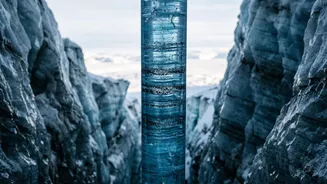
To access this archive, scientists drill deep into the ice sheets, extracting long cylinders of ice called ice cores. Some of these cores can be over three kilometres long, representing a climate and atmospheric record going back as far as 800,000 years. Back in the lab, these cores are meticulously analysed. Scientists can melt sections of the ice, layer by layer, and use highly sensitive instruments like accelerator mass spectrometers to count the tiny number of ¹⁰Be atoms present in each sample. By dating the layers of ice, they can create a precise, year-by-year record of how ¹⁰Be concentrations have changed over time.
What the Variations Tell Us
This is where the story comes full circle. Since the amount of Beryllium-10 is directly linked to the number of cosmic rays hitting the atmosphere, its concentration in ice cores acts as a proxy, or indirect measure, for past cosmic ray flux. A layer of ice with a high concentration of ¹⁰Be indicates a period when more cosmic rays were reaching Earth, which corresponds to a time of low solar activity (a weaker solar shield). Conversely, low ¹⁰Be levels point to periods of high solar activity, when a stronger Sun deflected more cosmic rays. This allows scientists to reconstruct the Sun's behaviour long before humans began observing it, identifying periods of intense solar storms or unusual quiet spells, like the 'Maunder Minimum' in the 17th century when sunspots famously vanished.