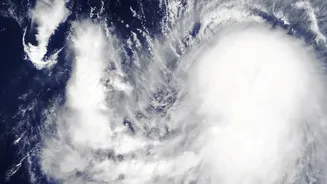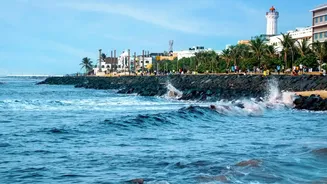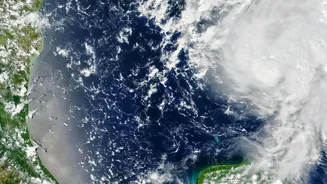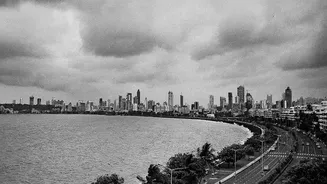




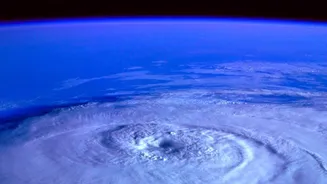
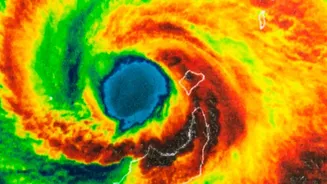

For generations, Indians have known the Bay of Bengal as the primary source of cyclones. But that old certainty is eroding as the once-calmer Arabian Sea begins to churn with more frequent and intense storms, rewriting our climate risk map.
A Tale of Two Seas
Historically,
India's eastern and western coasts have experienced vastly different cyclone seasons. The Bay of Bengal has long been the subcontinent's storm engine. Its unique, semi-enclosed shape, warmer sea surface temperatures, and remnants of typhoons from the Pacific have traditionally made it a hotbed for cyclonic activity, accounting for about four times as many cyclones as its western counterpart. For states like Odisha, West Bengal, and Andhra Pradesh, preparing for cyclones is an almost annual affair. In contrast, the Arabian Sea has been relatively placid. Cooler water temperatures and less favourable atmospheric conditions meant that while cyclones did form, they were generally fewer and weaker, often veering away from India's west coast.
The Arabian Sea Awakens
That long-standing balance is now shifting. In recent decades, scientists have observed a startling increase in the frequency, duration, and intensity of cyclones in the Arabian Sea. One study noted a 52% rise in the number of cyclones in the Arabian Sea between 2001 and 2019, with a 150% increase in very severe cyclonic storms. This change is strongly linked to rapidly warming waters. The Indian Ocean is warming faster than other global oceans, and the Arabian Sea, in particular, has seen surface temperatures rise by as much as 1.2 to 1.4 degrees Celsius. This excess heat provides more energy for storms to form and, crucially, to undergo 'rapid intensification'—a phenomenon where a storm's wind speed increases dramatically in a short period, leaving less time for effective warnings and evacuations.
An Evolving Bay of Bengal
While the Arabian Sea is becoming more active, the Bay of Bengal's behaviour is also changing, albeit differently. Some studies suggest a slight decrease in the overall frequency of cyclones forming there. However, this doesn't mean the threat has lessened. The cyclones that do form are showing worrying trends. One observation flagged by the India Meteorological Department (IMD) is that storms are slowing down as they approach the coast. A slower-moving cyclone, even with the same wind speed, can inflict far greater damage because it lingers over an area for longer, dumping immense amounts of rain and causing prolonged periods of destructive winds, as seen with Cyclone Arnab in late October 2026.
The Fog of Forecasting
These evolving storm dynamics present immense challenges for forecasters. While the IMD has made significant strides in predicting the track and intensity of cyclones, some aspects remain incredibly difficult to model with certainty. Predicting the exact amount of rainfall a cyclone will bring, for instance, is still a major hurdle. The rapid intensification of storms is another area of uncertainty, as traditional models often struggle to anticipate these sudden bursts of power. Furthermore, longterm projections under climate change are complex. While models generally agree on a future with more intense storms due to warmer oceans, projecting the exact number of cyclones per season is less certain. Some nearfuture projections even suggest a potential decrease in the overall frequency of storms in the Bay of Bengal, even as their destructive potential grows.
Preparing for an Unpredictable Future
The message from the changing seas is clear : India's cyclone risk profile is no longer static . The west coast , once considered relatively safe , must now bolster its preparedness for more frequent and powerful storms . For the east coast , the challenge is adapting to storms that may behave differently than in the past , perhaps moving more slowly or carrying more rain . This new reality demands a multipronged approach . It requires not only more sophisticated forecasting models but also strengthening infrastructure , protecting natural barriers like mangroves , and ensuring early warning systems reach the last mile , especially in remote coastal and island communities . The backtoback cyclones Arnab and Murasu in late 2026 served as a stark reminder that preparing for individual storms is not enough ; building resilience to a more volatile and uncertain climate is the ultimate goal .