



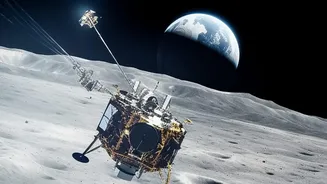

Mars has long captivated humanity, but its two tiny moons, Phobos and Deimos, remain one of the solar system's great unsolved mysteries. An ambitious new mission led by Japan is about to change that, travelling across the void to find answers.
A Mission to Solve a Martian Riddle
The Martian
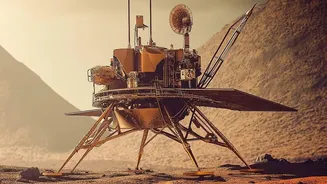
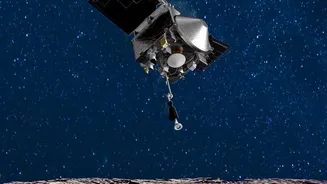
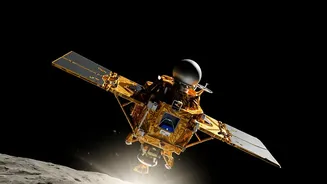
Moons eXploration (MMX) mission, led by the Japan Aerospace Exploration Agency (JAXA), is one of the most complex interplanetary voyages ever attempted. Launched in October 2026, its primary goal is to study both of Mars's moons up close and, for the first time in history, land on Phobos, collect a sample of its surface, and return it to Earth for analysis. Building on the success of its Hayabusa missions, which returned samples from asteroids, JAXA is now aiming for a celestial body in the orbit of another planet. This round-trip journey will test new technologies for deep space travel and low-gravity landings, paving the way for future exploration.
Captured Asteroids or a Giant Impact?
Scientists are divided by two main theories about how Phobos and Deimos came to be. One theory suggests they are ancient asteroids that wandered too close to Mars and were captured by its immense gravity billions of years ago. Their small, lumpy, and irregular shapes certainly resemble asteroids found elsewhere in the solar system. The competing theory posits that a massive object, perhaps a protoplanet, crashed into a young Mars. The resulting debris would have been thrown into orbit and eventually clumped together to form the two moons, much like how Earth's own moon is believed to have formed. The answer will reveal crucial details about the chaotic early history of our solar system.
The Five-Year Journey Plan
MMX has a long and complex journey ahead. After its 2026 launch, the spacecraft will cruise for about a year, arriving in orbit around Mars in August 2027. From there, it will spend three years meticulously studying the Martian system. The probe will first enter a special orbit around Phobos to map its surface in high resolution, identifying a safe and scientifically interesting landing spot. In 2029, it is scheduled to touch down on the surface of Phobos at least once to collect a minimum of 10 grams of regolith, or surface material. The spacecraft will also conduct multiple flybys of the smaller, more distant moon, Deimos, to gather comparative data before beginning its year-long journey home in 2030. If all goes to plan, the precious sample capsule will land in Australia in 2031.
A Rover and a Suite of Instruments
The MMX spacecraft is packed with more than a dozen scientific instruments to analyse the moons. These include spectrometers to determine mineral composition, cameras for high_resolution imaging, and dust monitors. One of the mission's most exciting elements is a small, 25_kilogram rover named Idefix, provided by the French (CNES) and German (DLR) space agencies. The rover will be deployed onto Phobos before the main spacecraft lands. Due to the moon's incredibly weak gravity—about 2_000 times less than Earth's—the rover will be gently dropped from an altitude of about 100 metres. It is designed to operate for about 100 days, exploring the surface and providing ground_level context for the samples MMX will collect.
An International Effort for a Martian Prize
While JAXA is leading the mission, MMX is a significant international collaboration. NASA has contributed key instruments, including a gamma_ray and neutron spectrometer called MEGANE to analyse the elemental composition of Phobos, and a pneumatic sampler that uses nitrogen gas to collect surface material. European partners, including CNES, DLR, and the European Space Agency (ESA), have provided the Idefix rover and communications support. In exchange for these contributions, partner agencies will receive a share of the returned samples for study, ensuring that scientists around the globe can work to decode the secrets held within this piece of the Martian system.