

A New Way of Seeing Skies
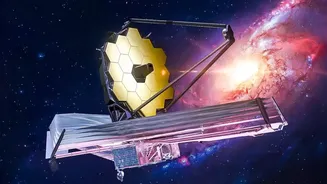
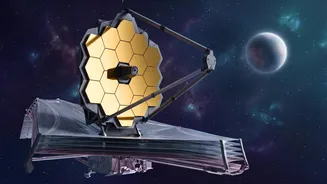
For decades, finding exoplanets was a numbers game—spotting the faint dip in a star’s light as a planet passed in front of it. Characterising their atmospheres, however, was incredibly difficult. The James Webb Space Telescope (JWST) changed the game.
With its powerful infrared instruments, it can perform a technique called spectroscopy. As starlight filters through a planet’s atmosphere, different molecules absorb specific wavelengths of light. This leaves a unique chemical “fingerprint” that Webb can read. Water, methane, and carbon dioxide each have a distinct signature, and for the first time, we have a tool sensitive enough to detect these faint signals from trillions of kilometres away. This capability is transforming the hunt for habitable worlds from a theoretical exercise into an observational science.
Mapping an Ultra-Hot World's Weather
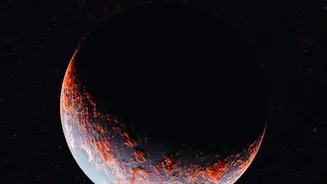
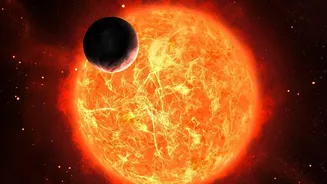
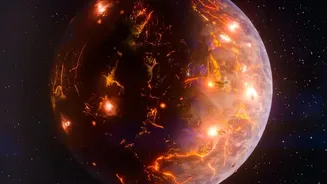
One of the most stunning demonstrations of Webb’s power comes from its observations of WASP-18 b, an “ultra-hot Jupiter” located 400 light-years away. This gas giant is ten times more massive than our Jupiter and orbits its star in a blistering 23 hours. It’s tidally locked, meaning one side perpetually faces the star’s intense heat, reaching temperatures of nearly 2,700 degrees Celsius. Scientists used Webb to create the first-ever temperature map of this planet. The data revealed a staggering temperature drop from the permanent day side to the terminator (the line between day and night). This suggests that something is preventing winds from efficiently distributing heat to the dark side. Even more remarkably, Webb detected the subtle signature of water vapour. At these temperatures, water molecules should be torn apart, so its presence, even in small amounts, hints at complex atmospheric processes. The key takeaway is about distribution: the water and heat are not spread evenly, giving us our first real glimpse into the weather on an alien gas giant.
The Puzzling Case of a 'Hycean' World
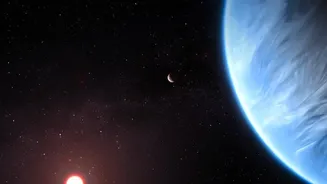
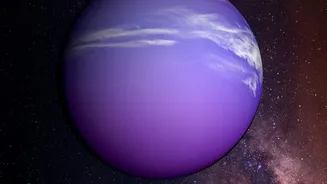
Not all planets are as extreme as WASP-18 b. K2-18 b, a “super-Earth” eight times the mass of our planet, has long been a prime target in the search for habitable worlds because it orbits within its star's habitable zone. Initial observations with the Hubble telescope found hints of water vapour. But Webb’s more detailed analysis has revealed a far more complex picture. The telescope confirmed the presence of methane and carbon dioxide in its atmosphere, but the water vapour signal was less prominent than some models predicted. This has led to a fascinating new theory: K2-18 b could be a “Hycean” world—a planet with a liquid water ocean hiding beneath a thick, hydrogen-rich atmosphere. The muted water vapour signal in the upper atmosphere could be the result of a “cold trap,” where water condenses into rain and falls back into the massive ocean below. Webb's data isn't just saying “water, yes or no”; it's giving scientists clues to infer a global water cycle and an entirely new class of planet.
Finding Water at the Source
Perhaps the most profound recent discovery concerns not a planet, but a planetary nursery. Webb was pointed at PDS 70, a young star 370 light-years away where planets are actively forming. For the first time, Webb detected a large reservoir of water vapour in the inner region of the star’s protoplanetary disk—the exact area where rocky, Earth-like planets are expected to assemble. This is the zone within 160 million kilometres of the star, equivalent to the region of our own solar system that contains Earth. While astronomers have seen water in the outer, colder regions of such disks before, finding it in the warm, terrestrial planet-forming zone is a landmark discovery. It directly addresses the long-standing question of how planets like ours get their water in the first place. This finding suggests that the essential ingredients for life are available right from the start, baked into the very material that forms new worlds.