




The Galaxy’s Most Famous Planets
Ever since its discovery, the TRAPPIST-1 system has captured the imagination of scientists and the public alike. It’s a compact solar system orbiting a cool, red dwarf star, but its main attraction is the seven Earth-sized rocky planets it holds. At least
three of these worlds orbit within the star’s ‘habitable zone,’ a region where conditions might be right for liquid water to exist on the surface. This makes it a prime laboratory for one of the biggest questions in science: are we alone? To answer that, we first need to know if these planets even have atmospheres, the protective blankets essential for life as we know it. This is the precise task the James Webb Space Telescope was designed to tackle, using its powerful infrared instruments to hunt for the chemical signatures of air on these distant worlds.
Hoping for a Venus Twin
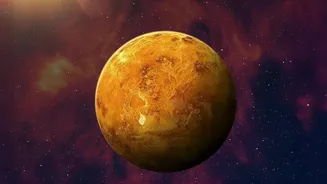
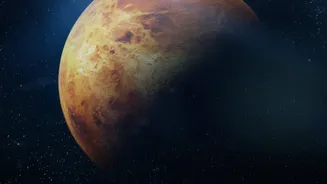
The first planets to get a detailed check-up were the two innermost worlds, TRAPPIST-1b and TRAPPIST-1c. Because of their proximity to their star, scientists theorised they might be Venus-like, with thick, heavy atmospheres dominated by carbon dioxide. A dense CO2 atmosphere would trap heat, creating a powerful greenhouse effect. Detecting such an atmosphere was considered a key first test for JWST. Using a clever technique, astronomers measured the heat radiating from the planets. If a thick CO2 atmosphere were present, it would absorb certain wavelengths of this infrared light, making the planet appear dimmer to the telescope's sensitive instruments. The team pointed Webb’s Mid-Infrared Instrument (MIRI) at the system, waiting to see if the tell-tale signature of a carbon-rich atmosphere would appear.
A Surprising Lack of Air
The results, however, were not what many expected. For TRAPPIST-1c, the data showed it was surprisingly hot on its dayside, reaching temperatures around 110 degrees Celsius. This high temperature meant it could not have a thick, Venus-like CO2 atmosphere, which would have redistributed heat more evenly. Instead, the findings suggest that TRAPPIST-1c is either a bare rock with no atmosphere at all, or has only a very thin, tenuous one. Similarly, observations of the innermost planet, TRAPPIST-1b, also failed to find evidence of a substantial atmosphere. More recent analyses show the data could be explained by a surface of unweathered volcanic rock, or possibly a hazy CO2 atmosphere, but a thick, protective blanket of gas was ruled out. The headline-grabbing idea of heavy carbon atmospheres seems to be the opposite of what Webb has found so far.
The Case of the Missing Atmosphere
So, where did the air go? The prime suspect is the parent star itself. Red dwarfs like TRAPPIST-1 may be cool, but they are notoriously active, especially in their youth. They can blast their nearby planets with intense ultraviolet and X-ray radiation, along with powerful stellar winds. Over billions of years, this constant bombardment can effectively strip a planet of its atmosphere, especially the inner worlds like TRAPPIST-1b and TRAPPIST-1c. Another possibility is that these planets formed with very little water and other volatile compounds like carbon dioxide to begin with. The absence of a thick atmosphere on these inner planets provides a crucial, if sobering, piece of the puzzle about the evolution of planets in red dwarf systems.
A Success Story for Science
While finding bare rock instead of a thick atmosphere might seem like a disappointment, it is actually a monumental scientific achievement. These measurements demonstrate the incredible power and precision of the James Webb Space Telescope. For the first time, we are able to distinguish between an Earth-sized rocky world with a thick atmosphere and one without, 40 light-years away. This is a critical capability that was impossible before JWST. By ruling out certain atmospheric models for the inner planets, scientists can now refine their theories and better focus their search. This 'negative' result is a vital positive step, proving our technology works and allowing astronomers to build a more accurate picture of which of the seven TRAPPIST-1 worlds are the best candidates for hosting an atmosphere—and perhaps, one day, life.