





Long before Earth and its planetary neighbours existed, the solar system was a swirling disc of gas and dust. How do we know? Because pieces of that ancient past fall to Earth as meteorites, carrying with them a 4.6-billion-year-old story.
Cosmic Time Capsules
Meteorites are
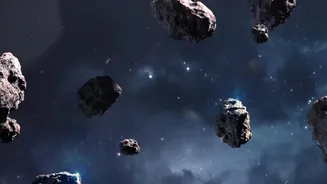
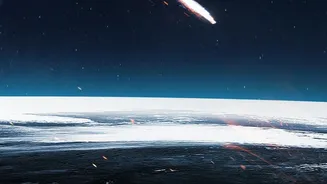
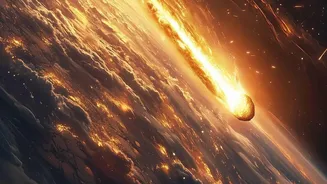
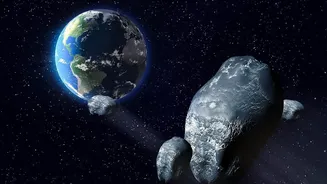
more than just space rocks; they are pristine relics from the dawn of our solar system. Most originate from the asteroid belt, where they remained largely unchanged while planets like Earth underwent dramatic geological transformations. This makes them invaluable time capsules, preserving the raw ingredients and conditions that existed as the solar system first began to form. By studying these visitors from space, scientists can piece together a history that has long been erased on our own geologically active planet. There are three main types: stony, iron, and stony-iron meteorites, each telling a different part of the story of how planets came to be.
Reading the Atomic Clock
One of the most powerful tools for studying meteorites is radiometric dating. This technique works like a precise atomic clock. Scientists measure the ratio of certain radioactive isotopes—atoms of an element with different masses—to their stable decay products. For example, specific isotopes of uranium decay into lead at a known, constant rate. By analysing these elements within a meteorite, researchers can calculate its absolute age with remarkable accuracy. It was through this method, pioneered in the 1950s, that scientists first determined the age of our solar system to be approximately 4.56 billion years old. Different isotopic systems, like Rubidium-Strontium or Samarium-Neodymium, provide cross-checks that confirm these ancient dates.
The Solar System’s First Solids
Many stony meteorites, called chondrites, contain tiny, spherical grains known as chondrules. These millimetre-sized droplets of rock are believed to be among the very first solid materials to form in the solar nebula. They were created by flash-heating events that melted dust aggregates, which then rapidly cooled into these distinctive beads before clumping together to form larger asteroids. The composition and texture of chondrules reveal the extreme temperatures and rapid changes that occurred in the protoplanetary disk. Another key component found in some meteorites are Calcium-Aluminium-rich Inclusions (CAIs). These are even older than chondrules and are considered the very first solids to have condensed from the cooling nebula, effectively marking 'Time Zero' for the solar system.
Unlocking Chemical Secrets
Beyond dating, scientists use a variety of spectroscopic techniques to decode the chemical makeup of meteorites. An electron microprobe, for instance, can perform a quantitative analysis of a meteorite's mineral composition. Techniques like Raman spectroscopy can identify a mineral’s molecular structure by shining a laser on it and observing how the light shifts. This is like taking a chemical fingerprint of the rock's components, which tells a story about the pressure and temperature conditions under which it formed. These analyses have shown that some primitive meteorites have a chemical composition similar to that of the Sun (minus the light gases), confirming they are made of the same primordial stuff.
Searching for the Building Blocks of Life
Perhaps most exciting is the discovery of organic compounds within certain meteorites, especially a type called carbonaceous chondrites. Analyses of meteorites like the famous Murchison meteorite have revealed the presence of dozens of different amino acids, the fundamental building blocks of proteins. While this isn't evidence of extraterrestrial life, it suggests that these essential ingredients for life may have been delivered to a young Earth by meteorite impacts. Scientists have even found that some of these meteoritic amino acids show a preference for the same 'left-handed' orientation used by life on Earth, a tantalising clue in the mystery of how life began.