




The Sun's Hidden Engine Room
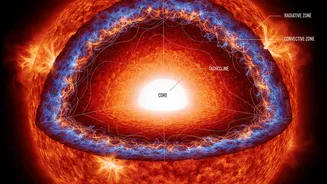
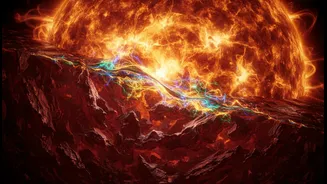
Deep beneath the fiery surface we see, the Sun has a complex interior structure. About 200,000 kilometres down, there is a boundary layer known as the tachocline. It is a relatively thin layer, only about 4% of the Sun's radius, but it marks a dramatic
transition. Above it lies the turbulent convection zone, where hot plasma boils and churns, rotating faster at the equator than at the poles. Below it is the radiative zone, a much calmer region that rotates like a solid ball. The tachocline is the shear interface between these two distinct rotating parts, a place of immense physical stress and activity. Scientists discovered this layer not by seeing it, but by studying solar vibrations, a field called helioseismology.
The Engine of the Solar Cycle
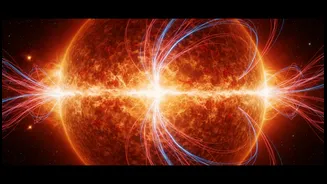
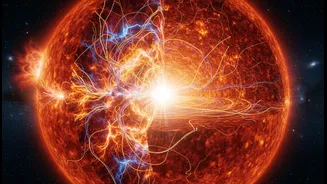
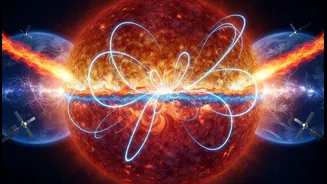
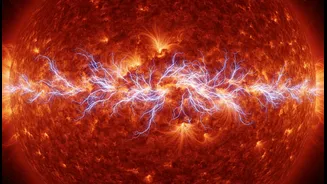
The immense shearing forces in the tachocline are believed to be the primary engine of the solar dynamo. This is the process that generates the Sun's powerful and ever-changing magnetic fields. As the faster-moving convection zone drags against the slower radiative zone, the tachocline stretches, twists, and amplifies magnetic field lines, winding them up like massive rubber bands. This stored magnetic energy is the source of virtually all solar activity, from the sunspots that pepper its surface to the 11-year solar cycle itself. It’s within this deep, hidden layer that the large-scale magnetic blueprint for the Sun's behaviour is drawn up over years and decades.
The Promise of Prediction
For solar physicists, the tachocline held an tantalising promise: if this is where the magnetic engine is, then understanding it could be the key to forecasting solar eruptions. The logic seemed simple. By monitoring the conditions and magnetic field strength in the tachocline, perhaps we could predict when a bundle of magnetic energy would become unstable, rise through the convection zone, and burst out as a solar flare or a coronal mass ejection (CME). These predictions are not just academic; in a world dependent on GPS, satellite communications, and stable power grids, advanced warning of major 'space weather' events is a critical national security and economic concern.
A Not-So-Perfect Crystal Ball
However, the reality of solar prediction is far more complex. While the tachocline is the source of the large-scale magnetic field that fuels the solar cycle, it does not dictate the precise timing and location of every eruption. Individual solar flares and CMEs are highly localised, relatively short-term events that happen in the Sun's upper atmosphere, the corona. The tachocline is like the factory that manufactures the gunpowder over many years, but the actual trigger for each explosion is pulled much later, in the Sun's outer layers, through processes like magnetic reconnection. Research now shows that while the tachocline sets the overall 'season' for solar activity, it can't tell you if a storm will hit on a specific day.
Beyond the Tachocline
This limitation has pushed scientists to look for more immediate precursors to solar eruptions in the layers they can directly observe: the photosphere (the visible surface) and the corona. Missions like India’s Aditya-L1 are at the forefront of this effort, providing an uninterrupted view of the Sun. Instead of just relying on the deep dynamo, researchers are using AI and detailed observations of surface magnetic fields, the lower atmosphere, and the corona to find short-term clues that an eruption is imminent. Aditya-L1's instruments, for example, allow scientists to analyse how energy from a flare propagates through the Sun's atmosphere, providing a more complete picture of the event. This is like moving from long-range seasonal forecasting to detailed, local weather radar.