




The Kayak Stroke: A Lesson in Rotation
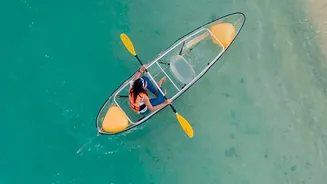
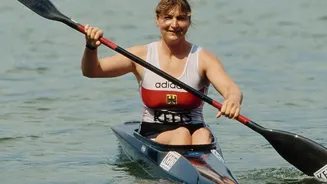
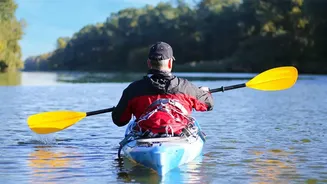
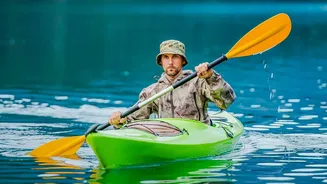
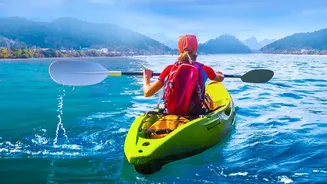
The power of a proper kayak stroke doesn't come from your arms. Instead, it originates deep in your core. Think of your torso as the engine. As you plant your paddle in the water (the 'catch'), you rotate your trunk, engaging your obliques. Then, you unwind
that rotation, pulling the blade alongside the boat. This movement heavily recruits the large, fan-shaped muscles of your back: the latissimus dorsi, or 'lats'. They are the primary movers responsible for the powerful pull that propels you forward. Your rhomboids and trapezius muscles, located in the upper back, also engage to control the paddle and stabilize your shoulder blades. It’s a workout focused on generating powerful, repetitive rotational force, making it an excellent activity for building upper-body pulling strength.
The SUP Stroke: A Full-Body Balancing Act
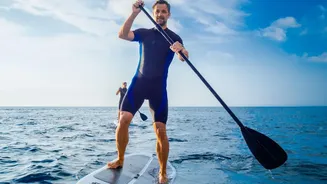
Stand-up paddleboarding introduces a fundamental challenge before you even take a stroke: balance. The simple act of standing on a board that is floating on water forces your entire body to work as a single, coordinated unit. Your feet, legs, and glutes are constantly making micro-adjustments. This engagement travels up your posterior chain to your core and back, which must remain braced to keep you upright. The SUP stroke itself is a different mechanical challenge. It’s a more vertical motion where you reach forward, plant the paddle, and pull your body past it. While this also engages the lats, the bigger story is the constant isometric contraction of the muscles along your spine (the erector spinae) and deep in your core as they work tirelessly to provide stability.
Power Pulls vs. Stabilizing Strength
So, what does this mean for your back? Kayaking provides a more isolated strength workout for the upper back. Each stroke is a distinct, powerful contraction, similar to doing a one-arm row in the gym. This is ideal for developing the 'pulling' muscles and building visible strength in your lats and rhomboids. Paddleboarding, on the other hand, provides a more endurance-based, stabilizing workout for the entire back. While the lats are working during the stroke, so is every other muscle from your neck down to your heels. It’s less about explosive power and more about sustained, functional strength and postural control. You are strengthening the crucial stabilizer muscles that support your spine in everyday life.
The Critical Role of the Core
You can't talk about a back workout without talking about the core, and this is where the two sports diverge significantly. In kayaking, the core's job is to generate rotational power. Your obliques contract and unwind to transfer force from your legs to your paddle. In paddleboarding, the core's primary job is stabilization. It acts as a rigid, central pillar, preventing you from tipping over as you paddle and contend with small waves or chop. This means paddleboarding delivers a more comprehensive core workout that heavily targets the transverse abdominis (the body's natural corset) and the lower back muscles, which are crucial for posture and preventing injury.
Choosing Your On-Water Workout
Ultimately, neither activity is 'better' than the other; they simply offer different benefits. If your main goal is to build a powerful upper back and enjoy a fantastic cardiovascular workout that focuses on pulling strength, kayaking is an outstanding choice. You’ll feel the burn primarily in your lats, shoulders, and arms. If you’re looking for a total-body workout that will seriously challenge your balance, strengthen your core from every angle, and improve your posture by building endurance in your spinal erectors, then stand-up paddleboarding is your answer. Whichever you choose, prioritising proper form is essential. Learning the correct stroke mechanics will not only make you more efficient but also protect your back and shoulders from strain.