



What Is a Planetary Alignment?
First, let's get one thing clear: a planetary 'alignment' or 'grouping' isn't what it sounds like from a sci-fi movie. The planets are not actually forming a perfect, straight line in three-dimensional space. If you could fly out in a spaceship, you’d
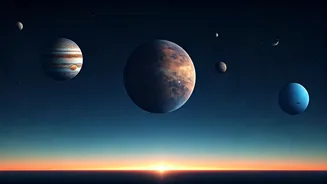
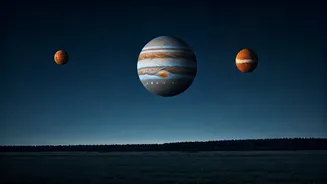
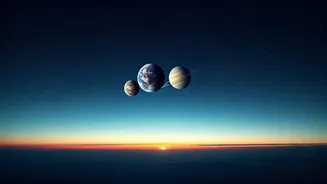
see they are still millions of kilometres apart, following their own distinct orbits around the Sun. What we are witnessing is a beautiful optical illusion from our specific vantage point here on Earth. From our perspective, the planets appear to be clustered together in a small section of the sky, creating a striking visual 'line-up' against the backdrop of distant stars. These events, also known as conjunctions or appulses, happen periodically as the planets—including Earth—move at different speeds in their orbits. It’s a game of cosmic perspective, and right now, we have the best seats in the house.
Meet the Celestial Trio
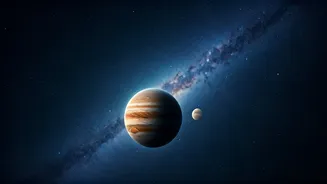
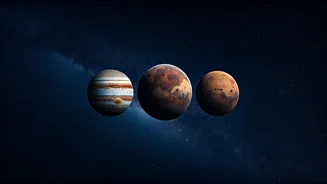
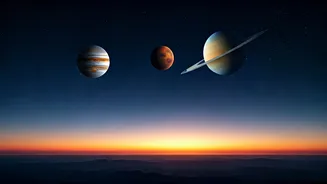
The stars of this show are three truly iconic members of our solar system: Mars, Jupiter, and Saturn. You're not just seeing faint dots; you're looking at entire worlds. Mars, the 'Red Planet', will be easy to identify by its distinct reddish-orange hue, a colour that comes from the iron oxide (rust) on its surface. It's our planetary neighbour, a world of fascination and future exploration. Then there's the undisputed king of the planets, Jupiter. It will likely be the brightest object in the lineup, outshining all the stars around it. This gas giant is so massive that all other planets in our solar system could fit inside it. Finally, you have Saturn, the jewel of the cosmos. While its famous rings aren't visible to the naked eye, its steady, yellowish-white light gives it a majestic presence. Seeing these three powerhouses together is a rare treat.
Your Guide to Spotting the Planets
The best part about this event is its accessibility. You don’t need to be in a remote observatory to enjoy it. The ideal time to look is shortly after sunset, once the sky has darkened enough for the planets to become visible. They will appear as bright, star-like objects that don’t twinkle as much as actual stars. Find a spot with a clear view of the horizon, away from the direct glare of city streetlights if possible—a rooftop, a balcony, or a local park is perfect. Look towards the western sky as dusk settles. The planets will form a diagonal line. To differentiate them, remember their characteristics: Jupiter will be the most brilliant point of light, Mars will have its signature reddish tint, and Saturn will glow with a calmer, pale-yellow light. Apps like Star Walk 2 or SkyView Lite can also help you identify them instantly by simply pointing your phone at the sky.
Do You Need a Telescope?
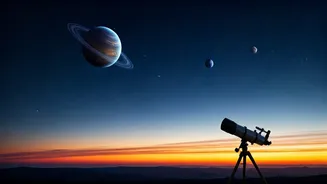
Absolutely not! This planetary grouping is a fantastic naked-eye event. The brightness of Jupiter and the distinct colour of Mars make them easy to spot without any equipment. However, if you have a pair of binoculars, you'll get an even better view. With a steady hand or a tripod, binoculars might even reveal Jupiter’s four largest moons—Io, Europa, Ganymede, and Callisto—as tiny pinpricks of light huddled close to the planet. If you are lucky enough to have a small amateur telescope, the experience becomes even more magical. A basic telescope will transform Saturn from a bright 'star' into a definite orb, and you may even be able to make out its magnificent rings. But don't let a lack of equipment stop you; the simple act of seeing these worlds with your own eyes is the real prize.