


A Volatile Recipe in the Himalayas
Flash floods in Nepal are not simple cases of heavy rain. They are the result of a volatile combination of factors unique to the Himalayan region. The world's tallest mountains provide extremely steep slopes, which give water immense speed and power.
These mountains are also geologically young and active, meaning the rock and soil are often unstable. Add to this the intense annual monsoon season and the effects of a warming climate on glaciers, and you have all the ingredients for a catastrophe. Most floods are not caused by one single thing, but a chain reaction of events.
Trigger 1: Glacial Lake Outburst Floods (GLOFs)
As global temperatures rise, glaciers in the Himalayas are melting at an accelerated rate. This meltwater often pools at the front of a retreating glacier, forming a large lake. These lakes are frequently dammed by nothing more than a moraine—a loose wall of soil, gravel, and ice left behind by the glacier. These natural dams are inherently unstable. An ice or rock avalanche falling into the lake can create a massive wave that overtops and breaches the dam. An earthquake can also destabilize it. When the moraine dam fails, the entire lake can empty in a matter of hours, releasing a catastrophic volume of water downstream.
Trigger 2: Landslide Dams
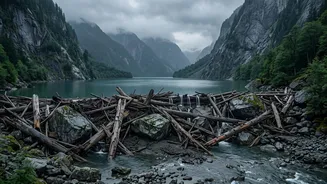
Another common trigger is a landslide. In the steep, narrow valleys of Nepal, an earthquake or heavy rains can cause a huge section of a mountainside to collapse into a river. This mass of rock and earth can create a temporary, but very effective, dam. Water builds up quickly behind this blockage. The pressure grows until the water either flows over the top of the landslide dam or the dam itself gives way under the strain. The result is similar to a GLOF: a sudden, high-velocity wall of water is unleashed down the valley. Many of these natural dams are short-lived, with a significant number failing within days or even hours of forming.
Trigger 3: Intense Monsoon Rains
While not as dramatic as a bursting lake, intense, concentrated rainfall during the monsoon season is a primary driver of flash floods. The steep, often deforested slopes cannot absorb the sheer volume of water from a cloudburst. The water runs off almost instantly, channelling into streams and rivers that can swell to many times their normal size in minutes. This is especially dangerous in areas where the soil has been baked dry by a preceding drought or hardened by wildfires, as the ground becomes water-repellent, increasing runoff. In Nepal, the monsoon brings relentless rainfall that saturates slopes, making them prone to landslides that can then lead to further flooding.
From Water to a Wall of Mud
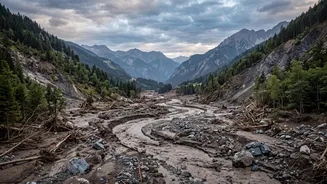
A key reason these events are so devastating is that they are not just floods of water; they are debris flows. As the initial torrent of water rushes down the steep mountain valleys, it has incredible erosive power. It scours the riverbed and banks, picking up immense quantities of loose soil, sand, gravel, and boulders. This deadly mixture, sometimes described as being like liquid concrete, is far heavier and more destructive than water alone. A debris flow can carry rocks the size of cars and can bury entire buildings under a thick, dense layer of mud and sediment that is incredibly difficult for rescue teams to dig through. This transformation from a flash flood to a debris flow is what causes the 'sudden surge of water and mud' described in headlines.