



What Did ISRO Just Accomplish?
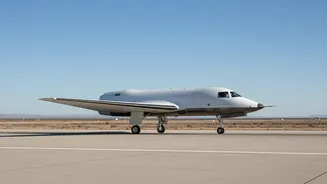
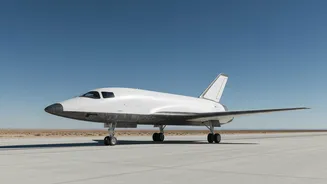
The Indian Space Research Organisation (ISRO) successfully completed a series of critical landing experiments for its Reusable Launch Vehicle (RLV) program. In the most recent test, known as the Landing Experiment (LEX-03), a winged vehicle named 'Pushpak'
was lifted to an altitude of 4.5 kilometres by an Indian Air Force Chinook helicopter and released. From there, Pushpak navigated on its own, corrected its path against challenging wind conditions, and executed a perfect, high-speed horizontal landing on a runway at the Aeronautical Test Range in Chitradurga, Karnataka. This simulated the difficult final moments of a vehicle returning from space, proving the autonomous landing systems are precise and reliable.
Meet 'Pushpak': India's Space Shuttle
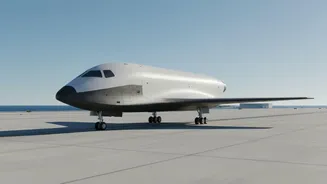
The vehicle at the heart of these tests is named Pushpak, a nod to the mythological flying palace from the Ramayana. This winged vehicle is the centrepiece of ISRO's Reusable Launch Vehicle - Technology Demonstrator (RLV-TD) programme. Unlike the booster-recovery model famously used by SpaceX, ISRO's approach involves a spaceplane that launches vertically like a rocket but is designed to land horizontally on a runway like an aircraft. This series of landing tests has been crucial for mastering the autonomous guidance, navigation, and control systems needed for a vehicle to land itself without any human intervention, especially during the high-velocity final approach which can exceed 320 kmph.
The Core Mission: Slashing Launch Costs
The primary driver behind developing reusable technology is economics. Currently, the most expensive components of a rocket, including its powerful engines and complex structures, are used only once before being discarded in the ocean or burning up in the atmosphere. This is akin to building a brand new aeroplane for every single flight. By designing a vehicle that can be recovered and reused for multiple missions, the cost per launch can be reduced dramatically. ISRO estimates that a fully realised reusable launch system could slash the cost of delivering payloads to Low Earth Orbit by as much as 80%, from the current tens of thousands of dollars per kilogram to just a few thousand. This would make India an even more competitive player in the global satellite launch market.
The 'Autonomous' Advantage
The word 'autonomous' is key to this entire achievement. Pushpak isn't being remotely piloted; it is flying itself. Using a sophisticated suite of sensors and advanced guidance algorithms, the vehicle can make real-time decisions to correct its flight path and line up perfectly with the runway, even when released from an off-nominal position or in windy conditions. This capability is absolutely critical for a vehicle returning from the unpredictability of space. Mastering this terminal phase of flight, where the vehicle is essentially a high-speed glider, is one of the most difficult challenges in developing a reusable spaceplane. The success of the LEX missions has validated ISRO's expertise in these essential technologies.
What's Next on the Road to Reusability?
These landing experiments, while historic, are just the beginning. They have successfully demonstrated that the vehicle can land. The next major challenge is the Orbital Re-entry Experiment. This will involve launching Pushpak into orbit on a conventional rocket, having it circle the Earth, and then guiding it to re-enter the atmosphere and perform an autonomous landing back at a runway. This will test the vehicle's thermal protection systems against the intense heat of re-entry and its ability to handle a much longer and more complex mission profile. Success in the orbital test will be the final step before developing a full-scale, operational two-stage-to-orbit reusable launch vehicle for India.