


The Constant Drag of Low Orbit
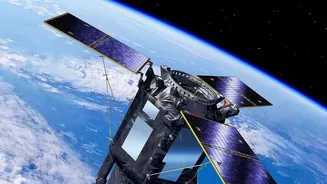
Even hundreds of kilometres above Earth, space isn't a perfect vacuum. The upper atmosphere contains a thin soup of gas molecules that, while sparse, create a persistent drag on satellites. This friction causes them to gradually lose speed and altitude,
a process known as orbital decay. To counteract this, satellites must fire their thrusters, but this consumes precious fuel. Once the propellant runs out, the satellite's mission is effectively over, and it eventually falls back to Earth, burning up on re-entry. This is a major limiting factor, especially for missions in Very Low Earth Orbit (VLEO), an altitude range below 400 kilometres that offers huge advantages for Earth observation and communications. The denser atmosphere at these altitudes means drag is significantly higher, shortening satellite lifespans to mere weeks or months without constant propulsion.
A 'Breath' of Fresh Air in Space
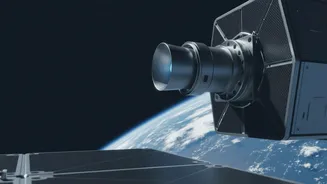
Imagine a satellite that never runs out of fuel because it 'breathes' its propellant from the very atmosphere that causes drag. This is the concept behind Air-Breathing Electric Propulsion (ABEP), also known as RAM-EP. Instead of carrying heavy tanks of propellant like xenon gas, an ABEP system uses a specially designed intake to scoop up the residual atmospheric particles. These captured molecules—mostly atomic oxygen and nitrogen at VLEO altitudes—are then channelled into an electric thruster. The technology effectively turns the problem (atmospheric drag) into the solution (a limitless source of propellant). This approach could theoretically allow a satellite to maintain its orbit indefinitely, limited only by the lifespan of its electronic components, not its fuel supply.
How It Turns Thin Air Into Thrust
The process is elegant and efficient. As the satellite speeds through its orbit at several kilometres per second, a collector funnels the scarce air molecules into a chamber. Inside, the gases are ionized, meaning their atoms are stripped of electrons to create a plasma—an electrically charged gas. This plasma is then accelerated by powerful electric and magnetic fields and expelled at extremely high velocity, generating thrust. This thrust is small but constant, perfectly suited to counteract the equally small but constant force of atmospheric drag. The entire system is powered by solar panels, making it a sustainable, self-perpetuating solution for staying in orbit. Development teams, including one led by the European Space Agency (ESA), have already built and successfully test-fired prototypes, proving the concept is no longer just a theory.
A New Frontier for Satellite Missions
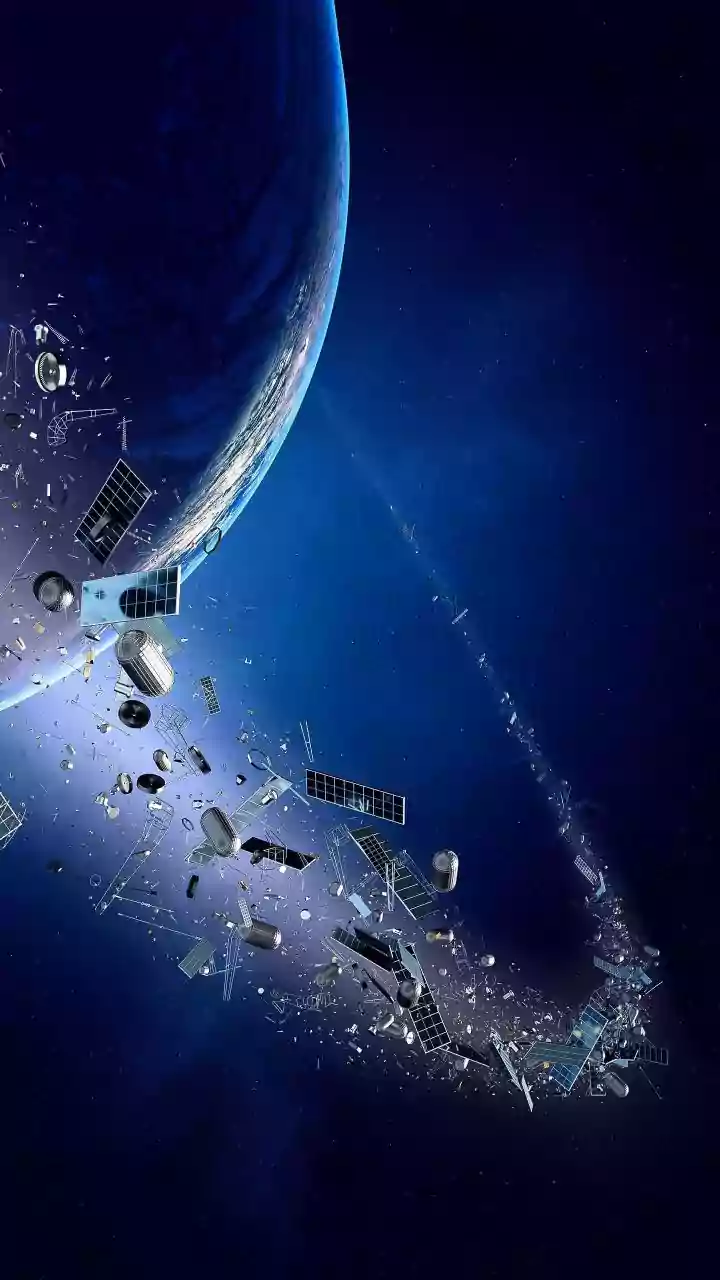
The implications of mastering ABEP technology are immense. It unlocks the full potential of Very Low Earth Orbit. Satellites in VLEO can capture much higher-resolution images and provide lower-latency communications than their counterparts in higher orbits. With ABEP, we could see persistent constellations of satellites for ultra-detailed environmental monitoring, disaster response, and next-generation internet services. Furthermore, this technology promotes a more sustainable use of space. Satellites in VLEO naturally de-orbit and burn up quickly once their mission ends, reducing the long-term problem of space debris. By eliminating the need for large propellant loads, ABEP also has the potential to reduce launch costs and complexity.