
The $10 Billion Wonder
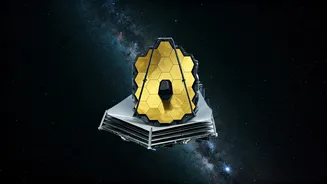
The object in question is the James Webb Space Telescope (JWST), the most powerful and complex space observatory ever built. Its total price tag is staggering, with NASA's contribution alone reaching nearly $9.7 billion for its development and initial
operations. When you add contributions from the European Space Agency (ESA) and the Canadian Space Agency (CSA), the total cost climbs even higher. This places it among the most expensive scientific platforms in history. The project, which was initially estimated to cost around $1 billion, saw its budget swell over two decades due to immense technological hurdles, redesigns, and the sheer complexity of its mission.
A Mission to See the Beginning of Time
So, what does a $10 billion telescope buy you? In short, the ability to see back to the dawn of the universe. JWST is designed to answer fundamental questions about our cosmic origins. Its primary mission is to hunt for the light from the very first stars and galaxies that formed after the Big Bang over 13.5 billion years ago. Unlike its predecessor, the Hubble Space Telescope, Webb is designed to see the universe in infrared light. This allows it to peer through massive clouds of cosmic dust that would otherwise obscure the view, capturing the faint, ancient light from the earliest moments of cosmic history.
Engineering an Impossible Machine
A huge portion of the cost came from inventing entirely new technologies that had never been tried before. JWST's iconic primary mirror, a massive 6.5-meter structure, is made of 18 gold-plated hexagonal segments. This mirror is so large it had to be folded, origami-style, to fit inside the launch rocket. To detect faint infrared signals, the telescope must be kept incredibly cold—below -223°C. This is achieved with a five-layer, tennis-court-sized sunshield that protects the delicate instruments from the heat of the Sun, Earth, and Moon. The complexity was enormous, and with its destination a million miles from Earth, there would be no chance for a repair mission like the ones that saved Hubble. It simply had to work perfectly the first time.
A New Era of Discovery
Since it began operations in 2022, the telescope has already delivered a spectacular return on investment, transforming astronomy. It has provided the first detailed look at a moon-forming disk around a distant exoplanet and studied the atmospheres of strange new worlds, including one with salty clouds. Scientists using Webb have discovered some of the earliest and most distant galaxies ever seen, challenging our theories on how quickly galaxies could form and grow after the Big Bang. From observing the birth of stars to analyzing the chemical makeup of comets, JWST is providing unprecedented insights into how our universe works. Each image and data point helps piece together the 13.8-billion-year story of our cosmos.