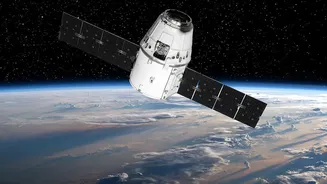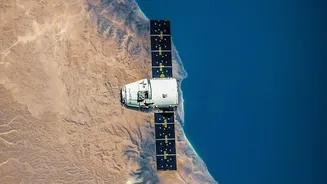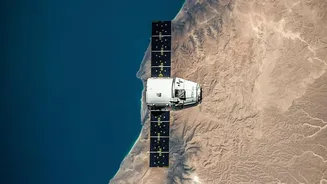








The concept of data centers in orbit sounds like science fiction, but SpaceX is making a serious bet that the future of artificial intelligence computing lies not on Earth, but in space. Here’s what that means and why it’s a strategic game-changer.
What is Orbital AI Computing?
At
its core, orbital computing is the idea of placing data centers—powerful computers for processing and storing information—onto satellites in space. Instead of sending massive amounts of raw data from satellites down to Earth for analysis, the processing happens right where the data is collected. This is a form of 'edge computing', which aims to reduce delays by processing data closer to its source. For years, this was limited to simple pre-processing to save on the time and energy it took to send information to the ground. However, what's now being discussed is far more ambitious: full-scale AI data centers in Low Earth Orbit (LEO) that could train and run complex AI models, functioning as a commercial service. The goal is to create a new layer of computational infrastructure for the entire planet.
Why Put Data Centers in Space?
The primary driver for moving AI to space is a looming bottleneck on Earth: energy. The massive data centers required for modern AI consume enormous amounts of power, straining terrestrial electrical grids and facing long delays for new connections and permits. In space, satellites have access to continuous solar power. Furthermore, the vacuum of space offers a natural, if challenging, environment for cooling powerful processors. Elon Musk has argued that these advantages will eventually make space a more cost-effective environment for AI infrastructure. Beyond logistics, orbital computing offers major strategic benefits. For time-sensitive applications like disaster response, military surveillance, or financial trading, processing data in orbit eliminates the latency of sending it to Earth and back. It also offers a potential security advantage by keeping sensitive data off terrestrial networks.
The Starlink Advantage
This is where SpaceX's existing infrastructure provides a massive head start. The Starlink constellation is more than just a system for providing global internet; it's a pre-built network in the sky. Newer generations of Starlink satellites are equipped with optical space lasers, allowing them to communicate with each other, forming a high-speed mesh network in orbit. This means data can be passed between satellites at incredible speeds without having to touch a ground station. By integrating powerful AI processors into future satellites, SpaceX could transform this communication network into a distributed supercomputer. The company has already made moves in this direction, with trademark filings for a service named 'Starmind' and FCC applications for a massive constellation of data-center satellites.
A New Space Race for Data
SpaceX is not alone in seeing the potential of cloud and AI services in space. Microsoft has its Azure Space platform, and Amazon's Project Kuiper presents a direct parallel to Starlink. These tech giants, along with others like Google and various startups, are all exploring ways to integrate their cloud services with satellite networks, creating a competitive new market for space_based data processing. Some companies are focused on building the platforms, while others are developing the specialized hardware needed to run AI in the harsh environment of space. This emerging ecosystem shows that orbital AI is being viewed not as a niche experiment, but as the next major frontier in cloud computing, with a market projected to be worth billions.
The Challenges Are Astronomical
Despite the bold vision, the hurdles are immense. Operating high_performance computers in space presents extreme engineering challenges. The hardware must be hardened to withstand cosmic radiation, which can corrupt data, and operate in extreme temperature variations. Dissipating the intense heat generated by AI accelerators in a vacuum is a major obstacle. Furthermore, once launched, repairing or upgrading these orbital data centers is nearly impossible. The entire enterprise hinges on the success and cost_effectiveness of fully reusable launch vehicles like SpaceX's Starship, which are needed to deploy the massive number of satellites required to make such a system viable. While initial tests are planned for as early as 2027, large_scale commercial deployment remains a long_term goal.