



The Universe's First Light
The 'ancient cosmic light' at the heart of this research is the Cosmic Microwave Background, or CMB. Think of it as the universe's baby picture. It’s the faint afterglow of the Big Bang, a wash of microwave radiation filling all of space, emitted when
the universe was just 380,000 years old. Before this point, the universe was a hot, dense, opaque fog. As it expanded and cooled, atoms formed, and light was set free for the first time. This light has been travelling across the cosmos ever since, carrying with it a snapshot of the infant universe. While almost perfectly uniform, sensitive telescopes can detect tiny temperature variations in the CMB, which hold clues to the universe's evolution.
Using Gravity as a Lens
Albert Einstein's theory of general relativity tells us that massive objects warp the fabric of spacetime. This means that light doesn't always travel in a perfectly straight line. As the ancient CMB light journeys across billions of years, its path is bent and deflected by the gravity of massive structures it passes, like galaxies and galaxy clusters. This effect is called gravitational lensing. By studying how the CMB light is distorted, astronomers can map out the distribution of mass, including mass that is otherwise invisible, across the vast expanse of the cosmos. This technique has allowed scientists to effectively use the entire universe as a giant telescope to probe its own history.
Putting Black Holes to the Test
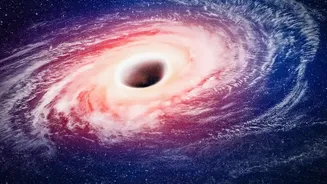
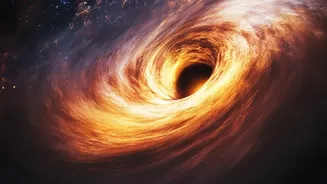
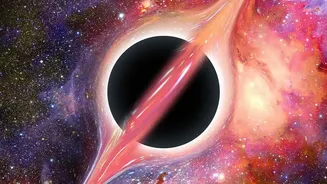
At the centre of most large galaxies, including our own Milky Way, lurks a supermassive black hole (SMBH)—an object with millions or even billions of times the mass of our sun. A major puzzle in astrophysics is how these behemoths grew so large, so quickly in the early universe. Recent discoveries by the James Webb Space Telescope have found surprisingly massive black holes existing less than a billion years after the Big Bang, challenging existing theories. Scientists are now leveraging the power of gravitational lensing of the CMB to test theories about these giants. By looking for specific distortions in the CMB, they can infer the mass and influence of these huge black holes and the vast dark matter halos they reside in, even from cosmic infancy.
New Windows on Cosmic Mysteries
Recent studies and simulations are creating powerful new ways to cross-reference observations from telescopes like the Webb with predictions from cosmic models. One new simulation, called Lumina, models the period when the first stars and black holes began to ionize the gas around them, ending the cosmic dark ages. It predicts how radiation from these early black holes helped shape the universe, creating 'bubbles of ionization'. By comparing these predictions to the subtle lensing patterns in the CMB and direct observations of distant galaxies, researchers can refine their understanding of how galaxies and their central black holes co-evolve. For example, some findings suggest that in certain systems, the host galaxy grew faster than its black hole, hinting that the relationship between them is more complex than a simple one-to-one growth.