
The Ultimate Insurance Policy
In human spaceflight, the launch is the most perilous phase. For a few minutes, astronauts ride a controlled explosion, where any malfunction could be catastrophic. This is why ISRO has poured immense effort into developing the Crew Escape System (CES)
for its Gaganyaan mission. Think of it as the ultimate insurance policy. Its sole job is to get the crew module—and the astronauts inside—away from a failing rocket in the blink of an eye. The system must be powerful enough to out-accelerate a malfunctioning launch vehicle, yanking the crew to a safe distance where they can deploy parachutes for a safe landing. This technology is not just an add-on; it is a fundamental requirement for a human-rated spacecraft, proving that astronaut safety is the absolute cornerstone of the program.
Anatomy of a Split-Second Escape
So how does it work? The Gaganyaan's CES is a 'puller' type system, similar to those used on the historic Apollo and Soyuz missions. It sits atop the crew module like a tower, armed with a set of powerful, quick-firing solid motors. An advanced onboard computer system, the Integrated Vehicle Health Management system, constantly monitors the rocket's vital signs. If it detects a critical anomaly—like a loss of thrust or a dangerous deviation from its flight path—it autonomously triggers the abort sequence within milliseconds. In that instant, pyrotechnic charges sever the connection to the rocket, and the escape motors fire with immense force, pulling the crew module clear of the danger zone. This subjects the crew to very high, but survivable, gravitational forces for a few crucial seconds.
Testing for Every Nightmare Scenario
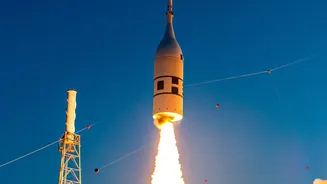
Engineers cannot leave such a critical system to chance. ISRO has planned a meticulous series of abort tests to validate the CES across different failure scenarios. The two most important types are the Pad Abort Test and the In-flight Abort Test. A Pad Abort simulates a catastrophic failure while the rocket is still on the launchpad. In July 2018, ISRO successfully conducted this test, where the escape system fired to pull the module away from a stationary test rig, reaching a safe altitude before splashing down in the sea. The more complex challenge is an in-flight abort. The Test Vehicle Abort Mission-1 (TV-D1), conducted in October 2023, was a landmark achievement. A dedicated test rocket carried a simulated crew module to an altitude of about 17 km at a speed of Mach 1.2—the point of maximum aerodynamic pressure. The abort was then intentionally triggered.
The TV-D1 Milestone: A Fiery Success
The TV-D1 mission was a comprehensive success, demonstrating the entire escape sequence in a real-world flight environment. After the abort command was given, the CES motors fired flawlessly, separating the Crew Module and pulling it away from the test vehicle. Once at a safe distance, the escape system jettisoned itself, and the Crew Module began its descent. A series of drogue and main parachutes deployed in sequence to slow the module down, ensuring a gentle splashdown in the Bay of Bengal, about 10 km offshore. The entire operation, from launch to recovery of the module by the Indian Navy, validated the design and performance of multiple interconnected systems. Even an initial launch hold, triggered by the onboard computer detecting an anomaly, demonstrated that the system's safety logic was working exactly as designed.