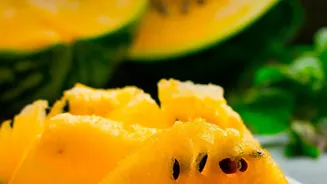







That thick, white and green rind from your summer watermelon likely goes straight into the bin. But what if that scrap was actually a versatile, nutritious, and delicious ingredient? It's time to rethink food waste and get creative in the kitchen.
Preparing the Rind
Before
you begin, it’s important to know that the entire watermelon rind is edible, though the tough outer green skin is often removed for textural reasons. To prepare it, simply use a vegetable peeler or a sharp knife to carefully slice off the dark green peel, leaving the thick white part. This white section is what you'll use for cooking. It has a crisp texture, similar to a cucumber or summer squash, and readily absorbs the flavours you cook it with. Nutritionally, the rind is a surprising powerhouse, containing fibre, vitamins A and C, and important minerals like potassium. It's also a significant source of citrulline, an amino acid that can improve blood flow.
The Classic: Tangy Watermelon Rind Pickles
Perhaps the most traditional use for watermelon rind, pickling transforms it into a sweet and tangy condiment that’s perfect alongside grilled meats or in a salad. The process is similar to making cucumber pickles. The prepared rind is typically boiled until tender, then simmered in a brine of vinegar, sugar, and pickling spices like cinnamon, cloves, and allspice. After marinating in the flavourful liquid, the rinds become translucent and bursting with a complex sweet-and-sour taste. Many recipes involve an overnight soak in a salt brine to draw out excess water and ensure a crisp texture. While it requires some patience, a jar of homemade watermelon rind pickles is a fantastic way to preserve a taste of summer.
A Savoury Surprise: Watermelon Rind Curry
In many parts of India, using watermelon rind in savoury dishes is common practice. When cooked, the rind softens and absorbs spices beautifully, making it an excellent addition to curries. In South India, it's used in yoghurt-based curries known as 'Majjige Huli' or 'Mor Kuzhambu'. These dishes balance the neutral flavour of the rind with a blend of coconut, chillies, and spices. Another approach is a North Indian-style 'subzi' or 'shaak', where the rind is pressure-cooked or pan-fried with onions, ginger, turmeric, cumin, and other aromatic spices until tender. The result is a hearty vegetable dish that pairs wonderfully with roti or rice, completely transforming the humble rind.
A Sweet Treat: Candied Watermelon Rind
For those with a sweet tooth, watermelon rind can be turned into a chewy, sugary confection similar to candied ginger or citrus peel. The process involves simmering pieces of the prepared rind in a rich sugar syrup until they become glassy and translucent. After simmering, the pieces are drained and rolled in granulated sugar to create a crystalline coating. Some recipes get creative, adding lemon, vanilla, or spices like cardamom and Szechuan peppercorns to the syrup for a more exotic flavour. These sweet gems can be enjoyed on their own as a candy or used in baked goods like fruitcakes and scones.
A Crisp Addition: Stir-Fried and Sautéed
Thanks to its firm, absorbent texture, watermelon rind is a fantastic vegetable for stir-frying. When julienned or cubed, it acts much like zucchini or carrots, remaining slightly crisp even after cooking. A common method is to heat sesame oil in a wok, then toss the rind with other vegetables like bell peppers and carrots. A sauce made from soy sauce, ginger, garlic, and a touch of honey or maple syrup glazes the rind, infusing it with savoury flavour. It can be the star of a vegetarian stir-fry or have protein like tofu or chicken added to make it a complete meal.
Beyond the Pan: Smoothies, Slaws, and Gazpacho
The versatility of watermelon rind doesn't stop with cooking. Its high water content makes it a hydrating and nutritious addition to smoothies; simply freeze cubes of the white rind to add a thick, slushy texture to your favourite blend. For a refreshing side dish, you can grate the raw rind and use it as a base for a crunchy coleslaw, dressed with vinegar, mustard, and herbs. Another no-cook option is a cooling gazpacho. Blended with tomatoes, cucumbers, peppers, and red onion, the rind adds body and a subtle, fresh flavour to the chilled soup. These recipes prove that even in its raw state, the rind has plenty to offer.