
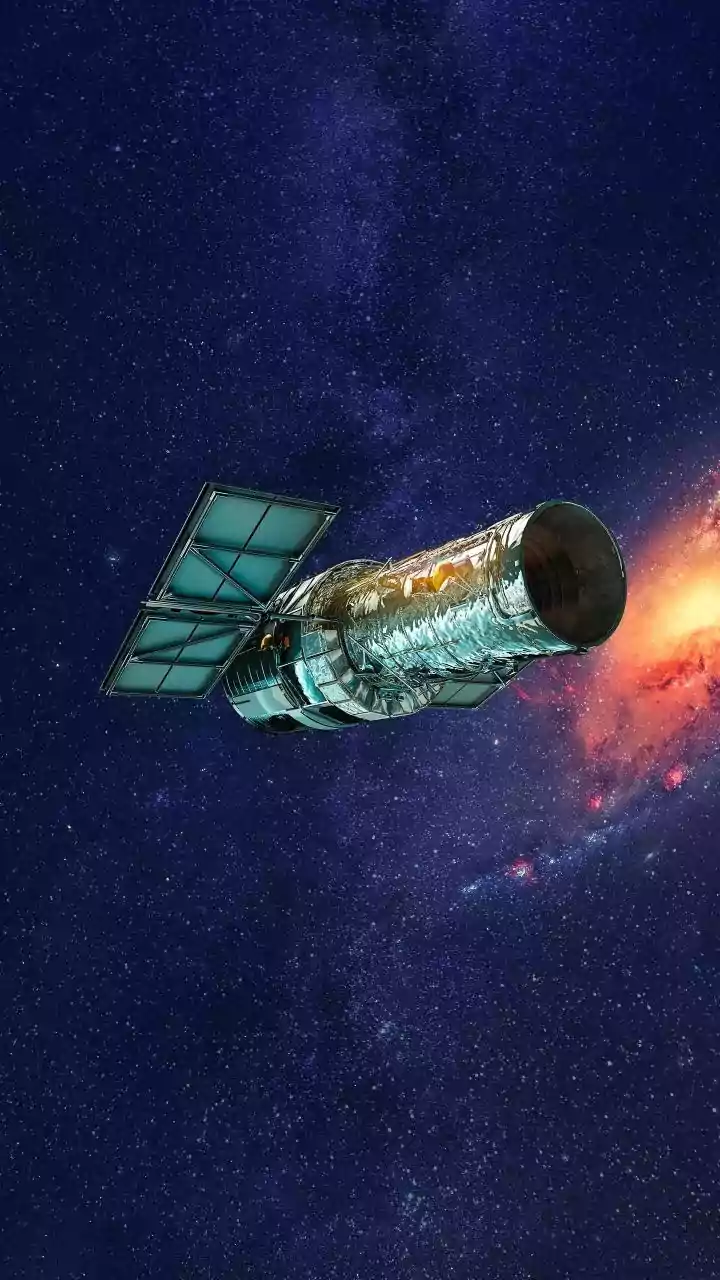




The Discovery: More Than a Drop in the Cosmos
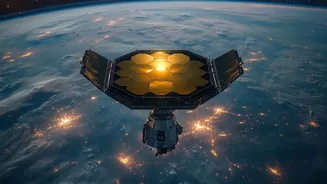
In a series of groundbreaking observations, the JWST has aimed its powerful infrared instruments at several 'super-Earths'—planets larger than Earth but smaller than Neptune. On at least one of these, Gliese 1214 b, scientists have found compelling evidence
for a steamy atmosphere rich in water. For over a decade, this planet, located about 40 light-years away, had baffled astronomers because a thick layer of haze or clouds obscured its atmosphere. The Webb telescope, however, managed to peer through this veil by analysing the heat radiating from the planet, confirming the presence of heavier molecules like water or methane. This marks one of the best pieces of evidence to date for an atmosphere surrounding a rocky planet outside our own solar system.
Meet the Super-Earths
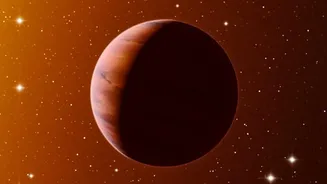
Super-Earths are one of the most common types of planets in our galaxy, yet there are none in our solar system. They represent a fascinating middle ground: rocky like Earth, but significantly larger and more massive. Take 55 Cancri e, another super-Earth studied by Webb, which is nearly twice the diameter of our planet. These worlds are often too hot to be habitable in the way we understand it. 55 Cancri e, for instance, orbits so close to its star that its surface is likely a molten ocean of magma. Gliese 1214 b is also too hot for liquid water oceans, with surface temperatures reaching up to 279 degrees Celsius. Despite the heat, the presence of a substantial atmosphere is a critical finding, offering a window into how these mysterious planets form and evolve.
How JWST Peers into Alien Atmospheres
So how does a telescope millions of kilometres away analyse the air of another world? The technique is called spectroscopy. When an exoplanet passes in front of its host star from our perspective, a tiny fraction of the starlight filters through the planet's atmosphere. Different gas molecules absorb specific wavelengths, or colours, of light, leaving behind a unique chemical fingerprint. By capturing this light with its incredibly sensitive infrared instruments, like the Mid-Infrared Instrument (MIRI), JWST can decipher which gases are present. For Gliese 1214 b, astronomers took this a step further, creating a 'heat map' by observing the planet through nearly its entire orbit to distinguish the temperatures and compositions of its day and night sides.
Water Vapour: A Key Ingredient, Not a Guarantee
Finding water is a monumental step in the search for extraterrestrial life, as it is a key ingredient for every living thing on Earth. However, its presence is not a guarantee of habitability. The conditions on these super-Earths are extreme. The water on Gliese 1214 b exists as a high-temperature, high-pressure 'steamy' atmosphere, not the life-sustaining liquid oceans we know. Likewise, while 55 Cancri e shows hints of an atmosphere that may be outgassed from its magma ocean, it is a hellish lava world. Scientists stress that while these findings are exciting, the primary goal is to understand what conditions allow a rocky planet to sustain an atmosphere at all—a crucial piece of the puzzle in identifying potentially habitable worlds in the future.
What Comes Next in the Search for Life?
These initial detections are just the beginning. The success with planets like Gliese 1214 b and 55 Cancri e demonstrates that JWST has the power to characterise the atmospheres of rocky worlds, a feat that was previously impossible. Astronomers are now applying these techniques to a host of other rocky planets, including some in the habitable zone—the region around a star where liquid water could exist. One such target is LHS 1140b, a rocky world orbiting a stable, older red dwarf star, which is now a prime candidate for atmospheric study. The ultimate goal is to find a rocky planet with not just water, but a cocktail of gases—like oxygen, methane, and carbon dioxide—that could point to biological processes. The search has just begun, but the toolbox is more powerful than ever.