







Our Galactic Cartographer
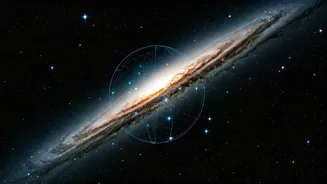
The incredible data comes from the European Space Agency's Gaia space observatory. Launched in 2013, Gaia’s mission is simple in concept but breathtaking in scale: to create the largest and most precise three-dimensional map of our Milky Way galaxy. For
years, it has been scanning the sky, repeatedly measuring the positions, motions, and brightness of nearly two billion stars. By observing each star an average of 70 times, Gaia can detect minute changes, charting not just where stars are, but where they are going. This ambitious census, covering about 1% of the total stars in our galaxy, is designed to reveal the Milky Way's composition, formation, and evolution in unprecedented detail. Its camera, the largest ever sent into space with nearly a billion pixels, can detect objects a million times fainter than the human eye can see.
The Stars That Act as Lighthouses
The focus of this massive data dump is on a special class of objects: variable stars. As the name suggests, these are stars whose brightness changes over time. While some dim because they are eclipsed by a companion star, others, known as pulsating variables, physically swell and shrink in a regular, repeating cycle. Two of the most important types are Cepheid and RR Lyrae variables. In the early 20th century, astronomers discovered a remarkable property of these stars: their pulsation period is directly related to their true brightness, or luminosity. This relationship turned them into cosmic lighthouses, or 'standard candles'. By measuring how long a Cepheid takes to pulse, astronomers can calculate its intrinsic brightness. By comparing that to how bright it appears from Earth, they can work out its distance with remarkable accuracy. This technique is a cornerstone of how we measure the size of the universe.
A Treasure Trove of Over 10 Million Stars
This is what makes the latest major dataset from Gaia, known as Data Release 3, so revolutionary. While previous star catalogues listed thousands or hundreds of thousands of variable stars, Gaia DR3 dropped a list containing over 10 million of them, increasing the known sample by more than an order of magnitude in one go. Released on June 13, 2022, this catalogue was the result of analysing 34 months of continuous observations. The sheer volume and precision of the data are staggering. The release includes not just the stars' locations but also their classifications into different variability types, from the crucial Cepheids and RR Lyrae stars to long-period variables and eruptive stars. This isn't just a longer list; it's a fundamentally new tool for understanding the cosmos, providing a rich, all-sky survey for astronomers to explore.
Rewriting the Cosmic Address Book
With this wealth of information, scientists can begin to refine our map of the universe. The vast number of RR Lyrae stars, which are often found in old star clusters, helps trace the ancient structure of the Milky Way, including its central bulge and surrounding halo. The thousands of newly catalogued Cepheids provide more 'standard candles' to measure distances to nearby galaxies with greater confidence, helping to resolve debates about the expansion rate of the universe. Beyond distance measurement, the data allows for deep dives into stellar physics. By studying the light curves—the plots of brightness over time—of millions of stars, researchers can test and improve models of stellar evolution, figuring out what goes on inside stars at different stages of their lives. It provides a stellar laboratory on a galactic scale, transforming what was once a difficult task of finding new variables into a new era of analysing a massive, pre-existing database.