



A Mission's Second Act
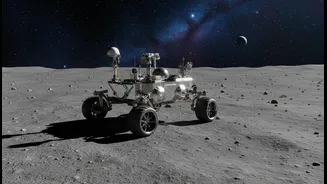
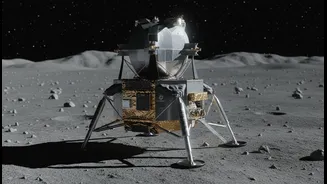
For many, the story of Chandrayaan-2, launched in July 2019, ended with the loss of communication with the Vikram lander just moments before its planned touchdown. But that was only the end of one chapter. The mission's other half, a sophisticated orbiter
packed with scientific instruments, achieved a flawless lunar orbit and began its own patient work. For years, it has been circling the Moon, collecting unprecedented data and laying the groundwork for a major scientific comeback. Recent findings, published by scientists at the Physical Research Laboratory in Ahmedabad, have confirmed that the orbiter's long vigil is paying off, shifting the mission’s legacy from a near-miss to a profound and ongoing scientific success.
The Radar That Sees Below
The star of this new chapter is the Dual-frequency Synthetic Aperture Radar (DFSAR). This powerful instrument is uniquely suited for a critical task: peering beneath the Moon's dusty surface. Unlike optical cameras that need light, DFSAR sends microwave signals that can penetrate the ground and reflect off buried materials, allowing scientists to map what lies beneath. It is the first fully polarimetric radar system sent to study the Moon, capable of analysing the properties of the reflected signals in great detail. This technology helps scientists distinguish between different materials, like rock and ice, turning the orbiter into a high-tech treasure hunter.
Unlocking Polar Mysteries
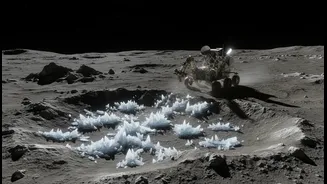
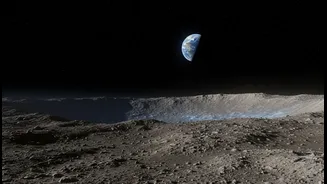
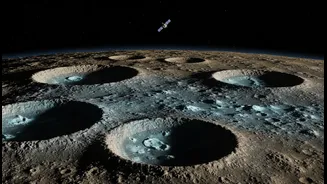
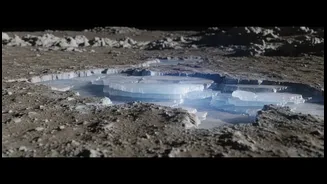
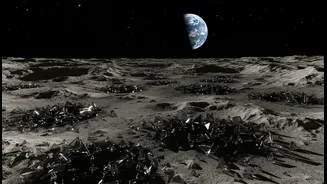
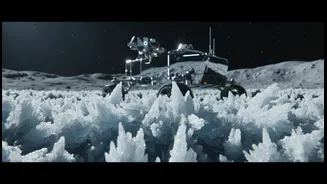
The search has focused on the Moon's south polar region, specifically in what are called "doubly shadowed craters." These are craters located inside larger, permanently shadowed regions (PSRs) where direct sunlight has never reached. In these ultra-cold traps, with temperatures dropping to around -248°C, water ice delivered by comets or asteroids could be preserved for billions of years. By analysing the DFSAR data from four such craters, scientists found strong radar signatures consistent with subsurface ice. The strongest evidence came from a 1.1-kilometre-wide crater inside the larger Faustini crater, which not only had the right radar profile but also a distinctive "lobate-rim"—a flow-like edge that suggests an ancient impact punched through an ice-rich layer.
The New Lunar Gold Rush
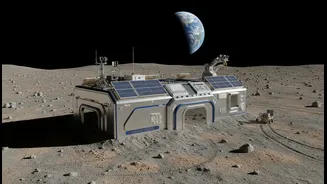
The confirmation of subsurface water ice is more than a scientific curiosity; it’s a resource that could fuel the next era of human exploration. This concept, known as in-situ resource utilization (ISRU), involves “living off the land” instead of transporting every resource from Earth at an enormous cost. Lunar ice can be converted into drinking water for astronauts, breathable oxygen, and, crucially, hydrogen and oxygen for rocket fuel. This could turn the Moon into a vital refueling station for more ambitious missions to Mars and beyond. By identifying specific, promising locations for this buried ice, Chandrayaan-2 is essentially drawing a treasure map for future lunar missions from India and around the world.
A Legacy Redefined
The latest findings cement Chandrayaan-2's place as a long-term scientific asset. While Chandrayaan-3 achieved the historic landing near the south pole in 2023, its predecessor continues to provide the wide-angle context from above, mapping resources and enhancing our fundamental understanding of the Moon. The data from its eight onboard experiments are being released to the global scientific community, ensuring its discoveries have a broad impact. The mission that once evoked a sense of national heartbreak is now a source of enduring pride, demonstrating resilience and proving that in space exploration, a quiet, long-term scientific investigation can be just as valuable as a picture-perfect landing.