







The Two-Key Process
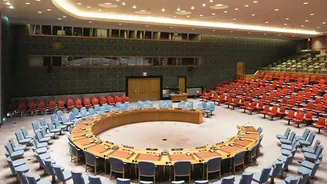
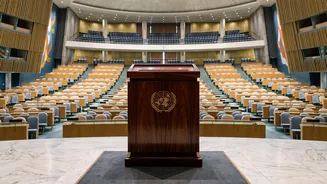
At its core, the selection of the Secretary-General is a two-stage process defined by Article 97 of the UN Charter. First, the 15-member Security Council must recommend a single candidate. Then, the 193-member General Assembly officially appoints that
candidate by adopting a resolution. While it sounds straightforward, the real power is concentrated in the first step. The General Assembly has never rejected a candidate recommended by the Security Council, making the Council's 'recommendation' the decisive moment in the entire process.
The Security Council's Decisive Role
The Security Council's deliberations are where the high-stakes political maneuvering truly happens. For a candidate to be recommended, they must secure at least nine affirmative votes. Crucially, this must include concurring votes from all five permanent members (P5): China, France, Russia, the United Kingdom, and the United States. A negative vote from any of these five acts as a veto, effectively eliminating a candidate. This veto power gives the P5 nations immense influence, ensuring that any chosen Secretary-General is not perceived as hostile to their core interests. To narrow the field, the Council holds several rounds of informal, secret 'straw polls' where members vote to 'encourage', 'discourage', or offer 'no opinion' on each candidate. In later rounds, color-coded ballots distinguish P5 votes from those of the ten elected members, revealing which candidates face a potential veto.
The General Assembly's Growing Voice
Historically, the General Assembly's role was seen as a mere 'rubber stamp' for the Security Council's choice, which was often made behind closed doors. However, a landmark General Assembly resolution in 2015 introduced significant reforms aimed at making the process more transparent and inclusive. Now, the process begins with a joint letter from the Presidents of the General Assembly and Security Council inviting member states to nominate candidates. These candidates submit vision statements and participate in public, webcasted 'informal dialogues' with the entire UN membership, allowing for broader scrutiny and engagement from all countries and even civil society. This has given the General Assembly a much more active and visible role, even if the final decision power still rests with the Council's recommendation.
The Unwritten Rules of the Game
Beyond the formal rules, several important but informal conventions guide the selection. One of the most significant is the principle of regional rotation. Although not a formal rule, it is widely accepted that the post should rotate among the UN's five regional groups: Africa, Asia-Pacific, Eastern Europe, Latin America and the Caribbean, and Western Europe and Others. This has become a powerful norm influencing which countries put forward candidates. Another long-standing tradition is that nationals from the P5 countries are not considered for the role to maintain a sense of impartiality. Furthermore, while the UN Charter does not specify a term length, a five-year term, renewable once for a total of ten years, has become the established practice. To date, no Secretary-General has served more than two terms.
A Process Under Scrutiny
Despite recent reforms, the selection process remains a subject of intense debate. The immense power of the P5 veto is a primary point of criticism, with many member states arguing that it makes the process undemocratic and leads to candidates who are seen as the 'least objectionable' rather than the most qualified. The geopolitical rivalries among the permanent members can lead to deadlocks and protracted selections, as seen in the race to succeed António Guterres, whose term ends on December 31, 2026. As of late November 2026, the Security Council has struggled to coalesce around a single candidate, with multiple straw polls failing to produce a clear frontrunner without veto threats. This has fueled calls for further reform, including the possibility of the Security Council recommending multiple candidates for the General Assembly to choose from, though this idea has been resisted by the P5.