





Beyond the Landing
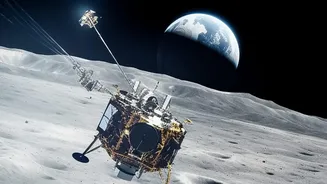
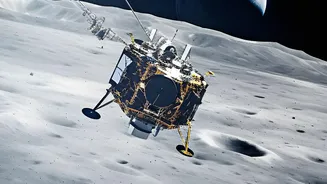
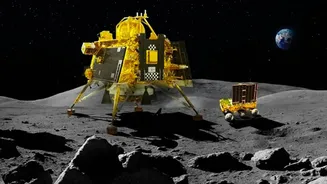
When the Vikram lander of the Chandrayaan-3 mission successfully touched down near the lunar south pole on August 23, 2023, it marked a monumental achievement for India. But the mission's true legacy is just beginning to unfold through the data it collected.
Scientists are now analysing findings that challenge long-held assumptions about the Moon's surface. A recent study published in November 2026 based on the lander's data shows that the lunar regolith—the layer of loose dust and broken rock—is not the homogenous sheet it was once thought to be. Instead, it’s a complex, layered structure, a finding that could change everything from how we land on the Moon to how we might one day live there.
A 'Cake-Like' Structure
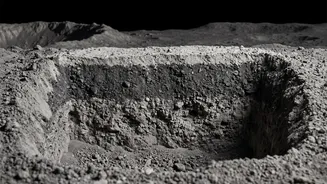
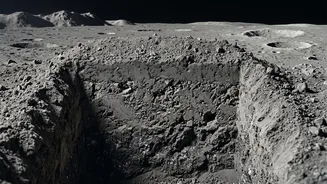
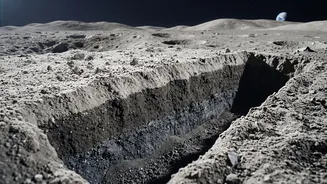
The key instrument behind this discovery is the Chandra's Surface Thermophysical Experiment (ChaSTE), a probe designed to measure the temperature profile of the top 10 centimetres of the lunar soil. An analysis published in the journal 'npj Space Exploration' reveals a fascinating, three-layer 'cake-like' structure at the Shiv Shakti Point landing site. The topmost layer, extending down about 3 cm, is highly porous and light, with a porosity of around 80%. Below that, from 3 to 6 cm, is a layer with higher thermal conductivity. The third layer, from 6 to 10 cm, is denser still. The soil's density more than doubles from the surface to a depth of just 10 cm, while its cohesiveness, or 'stickiness', increases fivefold. This means that while the surface might feel like walking on dry flour, just a few centimetres deeper, it behaves more like stiff, damp clay.
An Accidental Experiment Confirms It
This layered structure was further confirmed thanks to Vikram's ingenious 'hop' manoeuvre. Towards the end of its mission, the lander fired its engines to lift off and land again about 50 centimetres away. This act blew away the top 2-3 cm of loose dust, exposing the more tightly packed material underneath. When ChaSTE took measurements at this new spot, it confirmed the presence of a different, denser layer right at the surface. This 'accidental' experiment provided an unprecedented opportunity to compare a disturbed and an undisturbed site, solidifying the evidence that the lunar topsoil has distinct strata.
Why This Finding is a Game-Changer
The discovery that lunar regolith is not uniform has massive practical implications. For future missions, understanding the geotechnical properties of the surface is critical for the safety and success of landings, rover mobility, and construction. Equipment designed for a uniform, fluffy surface might struggle if it encounters a dense, cohesive layer just centimetres down. Furthermore, these properties affect how the Moon's surface retains resources. The porosity and thermal conductivity of the soil can influence whether precious water ice, thought to exist in the polar regions, is retained in the subsurface or lost to space. This discovery will be crucial for selecting sites for future scientific bases and resource extraction operations.
Rewriting the Moon's History
These layers are not just a curiosity; they are a historical record. Scientists from the Physical Research Laboratory (PRL), Ahmedabad, believe the layers were formed by successive meteorite impacts over billions of years. Ejecta from different impacts, including nearby craters, likely deposited material with different properties, creating the fine-scale layering observed by ChaSTE. Additionally, other instruments on the mission, like the APXS spectrometer, have found that the soil's elemental composition is also varied, suggesting material from the Moon's ancient mantle was excavated and thrown to the surface during the formation of massive basins. These findings provide a direct look into the Moon's violent past and early evolution.