




The Sky's Natural Searchlight
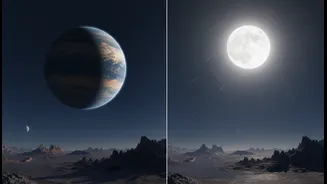
The Moon doesn't produce its own light; what we see as moonlight is simply sunlight reflecting off its surface. When the Moon is full and bright, it acts like a giant, natural floodlight in the sky. This phenomenon, often called 'moon glare', dramatically
increases the sky's overall brightness. A full Moon can be so bright that it washes out all but the most brilliant stars, creating an effect similar to the light pollution found in large cities. This background glow is the root of the Moon's dual role in astronomy. It fundamentally changes the contrast of the night sky, determining which celestial objects stand out and which ones disappear. The phase of the Moon, therefore, becomes the most critical factor for any night of stargazing.
Why Meteors Disappear in Moonlight
Meteor showers are the sworn enemy of a bright Moon. Most meteors, or shooting stars, are tiny particles of dust and debris burning up in Earth's atmosphere. They are often faint and incredibly fast. Trying to spot them in a moonlit sky is like trying to hear a whisper during a rock concert. The bright background light simply overpowers the fleeting streak of a meteor. While a bright Moon won't completely ruin a meteor shower—you might still catch a few exceptionally bright ones called fireballs—it dramatically reduces the number of visible meteors per hour. For instance, a shower that might produce 50 meteors per hour under dark skies could be reduced to just 10 or 20 when the Moon is out. This is why astronomers and avid sky-watchers meticulously plan their meteor-watching trips around the new moon, when the sky is at its darkest.
Planets: Bright Enough to Brave the Glare
Planets, on the other hand, are a different story. Unlike faint stars and meteors, the planets in our solar system—like Venus, Mars, Jupiter, and Saturn—are large objects that reflect a lot of direct sunlight. They are intrinsically bright and don't need a perfectly dark sky to be seen. In fact, they are often bright enough to remain clearly visible even with a full Moon nearby. Their steady light doesn't twinkle like distant stars, making them easier to distinguish. On some occasions, the Moon can even be a helpful guide. Because the Moon and the planets travel along a similar path across our sky, known as the ecliptic, a crescent Moon can often be seen near a bright planet, pointing the way for novice observers. So, if you step outside and the Moon is too bright for deep-sky gazing, it's the perfect opportunity to turn your attention to our planetary neighbours.
How to Plan Your Sky-Watching
So how can you make the Moon work for you? The key is planning. First, always check the lunar calendar before you head out. If you want to watch a meteor shower, like the upcoming Delta Aquariids in late July or the famous Perseids in August, aim for nights when the Moon is in its new or crescent phase. If a bright Moon is unavoidable, try to observe after the Moon has set or before it rises. You can also physically block the Moon's light by positioning yourself in the shadow of a building or a line of trees. Conversely, if your goal is to spot planets, a bright Moon shouldn't deter you. Use a stargazing app to identify which planets are visible. Jupiter and Saturn are often magnificent sights in the evening sky. Even with the Moon out, getting away from city lights will always improve your view by reducing artificial light pollution.