








Reality Check 1: 'Small' Gains and Dividends Are Not Invisible
A common myth among new investors is that small profits, dividends, or interest earned are too minor to report. The tax department, however, has a digital eye called the Annual Information Statement (AIS). The AIS compiles all your financial activities—from
savings account interest to every single stock and mutual fund transaction. The tax portal pre-fills this data, and any mismatch with your declared income is an instant red flag. Every single rupee of income, whether it's a ₹500 dividend or ₹2,000 in interest, must be reported. Ignoring these can lead to notices and penalties down the line.
Reality Check 2: All Profits Are Not Taxed Equally
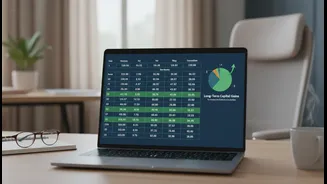
You might be celebrating a profitable year, but the taxman wants to know how you made that profit. There's a crucial difference between Short-Term Capital Gains (STCG) and Long-Term Capital Gains (LTCG). For listed equity, if you sell after holding for less than a year, your profit is an STCG, taxed at a higher rate. If you hold for over a year, it becomes LTCG, which is taxed at a lower rate and is tax-free up to a certain limit. Many young investors lump all their gains together, but failing to differentiate them correctly in your ITR can lead to paying more tax than necessary or, worse, incorrect filing.
Reality Check 3: The Futures & Options (F&O) Minefield
This is the biggest trap for young traders. Income from F&O is not treated as capital gains. It is considered 'non-speculative business income'. This has massive implications. Firstly, you must file ITR-3, a more complex form meant for business income. Secondly, you need to calculate your turnover, which is a specific calculation of the absolute sum of profits and losses. Thirdly, all your expenses related to trading—like brokerage, STT, and internet bills—can be deducted. If your turnover is high, you may even be required to get a tax audit. Simply showing F&O profit as 'other income' is a recipe for a tax notice.
Reality Check 4: Your Losses Are Valuable (If You Report Them)
Nobody likes to see red in their portfolio, but a loss in one investment can be a silver lining for your tax bill. This is called tax-loss harvesting. You can offset your capital gains with your capital losses, which reduces your overall taxable profit. For instance, a short-term capital loss can be set off against both short-term and long-term gains. However, there's a catch: to avail this benefit and carry forward any unadjusted losses for up to eight years, you MUST file your ITR by the original due date. If you file a belated return, you lose the right to carry forward most losses.
Reality Check 5: Crypto and Foreign Stocks Are on the Radar
Investing in US stocks or dabbling in crypto might feel like operating in a separate universe, but the tax department sees it all. Income from the transfer of Virtual Digital Assets (VDAs) like cryptocurrency is taxed at a flat 30% plus cess, and no loss from one VDA can be set off against the gain from another. Similarly, any investment in foreign stocks, even fractional shares, must be declared in Schedule FA (Foreign Assets). Non-disclosure can lead to severe penalties under the Black Money Act. These aren't areas for 'don't ask, don't tell'; they require explicit and accurate reporting.