







What Exactly Is Microgravity?
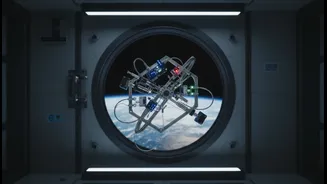
First, let's clear up a common misconception. Microgravity isn't the complete absence of gravity; it's more accurately described as a state of continuous freefall. Imagine being in an elevator when the cable snaps—for a few terrifying moments, you would
float inside, weightless. That's the principle ISRO and other space agencies use. On Earth, gravity's constant pull stirs liquids, causes denser materials to settle, and forces structures to support their own weight. By going into space—whether on a short-duration sounding rocket or a long-term mission on a space station—scientists can escape these constraints. In this environment, where the force of gravity is a millionth of what it is on Earth, phenomena that are normally hidden become visible, opening up an extraordinary laboratory for discovery.
ISRO’s Leap into the Weightless Frontier
ISRO is systematically building its capacity for microgravity research, seeing it as a crucial pillar for its future ambitions. This includes short-duration experiments on sounding rockets and orbital platforms, which provide brief but valuable windows of weightlessness. The real game-changer, however, is the Gaganyaan mission, India's first human spaceflight programme. Gaganyaan will not only prove India's capability to send astronauts to space but also serve as a platform for more complex, human-tended experiments in Low Earth Orbit. In preparation, ISRO is already collaborating on international missions, with Indian astronauts conducting experiments on the International Space Station (ISS) to study everything from muscle degeneration to how to interact with touchscreens in space. These initiatives are creating an ecosystem of scientists and engineers in India who are learning how to design and conduct research in this challenging environment.
The Science of a Gravity-Free World
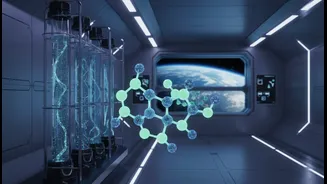
Why go to all this trouble? Because microgravity allows scientists to observe processes that are impossible to see on Earth. One of the most promising fields is medicine. On Earth, growing proteins into large, perfect crystals for drug development is incredibly difficult. In microgravity, without the deforming pull of gravity, these crystals can grow larger and more uniformly, which is crucial for designing more effective medicines. Similarly, stem cells can grow into three-dimensional tissues that more closely mimic human organs, offering better models for studying diseases like cancer and heart conditions. ISRO is actively pursuing this, with experiments designed to understand muscle atrophy, a major problem for astronauts that also has direct relevance to muscle-wasting diseases on Earth.
From Space Labs to Life on Earth
The benefits of this research are not confined to space. In materials science, microgravity allows for the creation of new metal alloys that would be impossible to mix on the ground, where heavier elements sink. These could lead to stronger, lighter materials for everything from aviation to consumer electronics. ISRO is also exploring space agriculture, studying how staple crops like moong beans and fenugreek grow in space. This knowledge is vital for sustaining long-duration missions but could also yield insights into creating more resilient crops in resource-scarce regions on Earth. Even experiments on how astronauts interact with computer screens could lead to better interface designs for high-stress jobs back home, such as in aviation or emergency response.
Building India's Future in the Stars
ISRO's focus on microgravity is a strategic investment in India's long-term space ambitions. The experience gained from Gaganyaan and other missions is a stepping stone towards building the Bharatiya Antariksh Station (BAS), India's own space station, planned for 2035. A national space station would give Indian scientists a permanent outpost for research, solidifying the country's position as a major space power. It would also enable the development of technologies essential for even more ambitious goals, such as a crewed mission to the Moon by 2040. By inviting proposals from the national research community, ISRO is ensuring that this journey is a collaborative one, tapping into the nation's brightest minds to unlock the secrets held in the weightless environment of space.