

Meet Pushpak: India’s Reusable Dream
Imagine if every time an airplane landed, it was thrown away. Air travel would be impossibly expensive. For decades, this has been the reality for space launches. The Indian Space Research Organisation (ISRO) is working to change this with its Reusable
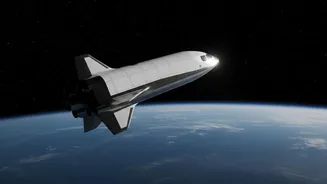
Launch Vehicle (RLV) program, nicknamed 'Pushpak'. This vehicle is a technology demonstrator, designed to test and perfect the complex systems needed for a vehicle to fly to space and, more importantly, return to Earth to be used again. Unlike a conventional rocket that is discarded after a single use, Pushpak is designed as a spaceplane that can land on a runway just like an aircraft, paving the way for a future of more affordable and sustainable space missions.
The Crucial Landing Experiments
The most challenging part of any reusable system is the return journey. To master this, ISRO has been conducting a series of Landing Experiments (LEX). In these tests, the uncrewed Pushpak vehicle is lifted to an altitude of 4.5 kilometres by an Air Force Chinook helicopter and released. From there, it's on its own. The vehicle must autonomously navigate its way to a runway, correct its path for winds and other disturbances, and perform a high-speed landing, touching down at over 320 kmph. The recent successful completion of the third LEX test demonstrated ISRO's mastery over this critical phase, proving its advanced guidance algorithms and autonomous control systems under increasingly challenging conditions. Impressively, the same winged body and flight systems from the second test were reused for the third, proving the hardware's robustness.
The Science of Saving Crores
The primary driver behind developing reusable vehicles is simple: economics. The most expensive parts of any rocket are its complex engines and structural stages, which in a traditional launch are discarded into the ocean. This 'use-and-throw' model means the full cost of manufacturing is borne by a single mission. A reusable launch vehicle, by contrast, can fly multiple missions. By recovering and refurbishing the most valuable components, the cost per launch can be slashed dramatically. ISRO's goal is to reduce the cost of delivering a payload to Low Earth Orbit significantly, potentially by up to 80 percent from current levels. This cost reduction doesn't just make existing missions cheaper; it opens up space for more frequent scientific experiments, commercial satellite deployments, and strategic applications.
India's Winged Approach
While companies like SpaceX have popularised vertical landings for their reusable rockets, ISRO is pursuing a winged-body, horizontal landing approach with Pushpak. This makes the vehicle more like a conventional spaceplane. This design uses aerodynamic lift during re-entry and approach, allowing it to glide towards a runway. While it presents its own set of aerodynamic and thermal protection challenges, a winged design offers different operational flexibilities. These tests are validating ISRO's unique approach and providing crucial data for designing a future operational vehicle. The autonomous landing system, which uses a fusion of sensors including NavIC, India's own satellite navigation system, has proven to be incredibly precise in guiding Pushpak to a perfect touchdown.
The Path to a Fully Reusable Rocket
The Pushpak tests are just the beginning. They are crucial steps in a much larger plan to develop a Two-Stage-To-Orbit (TSTO) fully reusable launch vehicle. In this future system, a reusable winged vehicle like Pushpak will act as the upper stage, carrying the payload to orbit. It will be launched atop a much larger, reusable first stage that will also return to Earth after providing the initial thrust. After deploying its satellite, the winged upper stage will re-enter the atmosphere and land autonomously on a runway, ready to be prepared for its next flight. The recently completed landing experiments are part of the technology demonstration phase, which will be followed by an Orbital Re-entry Experiment (ORE) where the vehicle will be launched into orbit and then perform an autonomous return and landing.