






The Core Paradox Explained
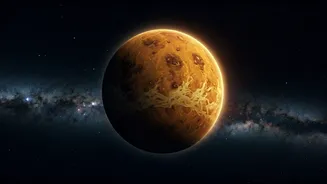
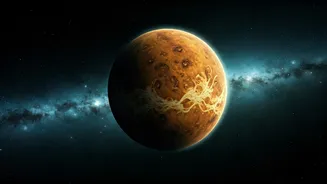
Let’s get the mind-bending numbers out of the way first. A year on Venus—the time it takes to complete one full orbit around the Sun—is approximately 225 Earth days. This is fairly standard. But a 'day' on Venus is where things get truly strange. A single,
full rotation of the planet on its axis, known as a sidereal day, takes an astonishing 243 Earth days. So, yes, you read that right: a day on Venus (243 Earth days) is longer than its year (225 Earth days). You would complete a full trip around the Sun before the planet you’re standing on has even finished spinning once. It’s a concept that breaks the familiar rhythm of day-follows-night-follows-day that governs life on Earth.
Not All 'Days' Are Created Equal
To make things even more confusing, there's another way to measure a day: the solar day. This is the time it takes for the Sun to return to the same position in the sky, a cycle of one sunrise to the next. On Earth, our sidereal and solar days are very close (about 23 hours 56 minutes vs. 24 hours). But on Venus, they are wildly different. Because Venus rotates backwards and very slowly, its solar day is significantly shorter than its sidereal day, clocking in at about 117 Earth days. So, while a single spin takes forever, you'd only have to wait about four Earth months for the next sunrise. This means Venus has less than two full solar days in its entire year. The sun also rises in the west and sets in the east, just to add another layer of weirdness.
Why the Slow, Backward Spin?
So, why is Venus the odd one out in the solar system? Most planets, including Earth, spin counter-clockwise on their axis, a relic from the swirling disc of gas and dust that formed our solar system. Venus, however, has what’s known as a retrograde rotation—it spins clockwise. Scientists have two main theories for this bizarre behaviour. The first is the 'giant impact' theory: early in its history, Venus may have been struck by a massive planet-sized object that completely reversed its spin. The second, more recent theory suggests that the planet's incredibly thick and heavy atmosphere is to blame. This dense blanket of gas could create a powerful 'thermal tide'—a wave of atmospheric pressure driven by solar heating—that exerts a braking force on the planet, slowing its rotation down over billions of years and possibly even flipping its orientation.
A World of Extremes
This strange timing has profound consequences for the planet itself. The incredibly long day-night cycle contributes to Venus’s extreme temperatures. The side facing the Sun bakes for months on end, while the night side also remains incredibly hot due to the thick, insulating atmosphere of carbon dioxide that traps heat like a runaway greenhouse. The surface temperature on Venus is a scorching 465° Celsius, hot enough to melt lead. This, combined with crushing atmospheric pressure 90 times that of Earth's, makes Venus one of the most inhospitable places in the solar system. Its slow rotation and extreme climate are deeply intertwined, painting a picture of a world that is both fascinating and terrifyingly alien.