




Taming the Data Tsunami
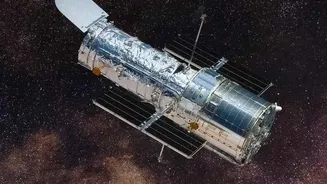
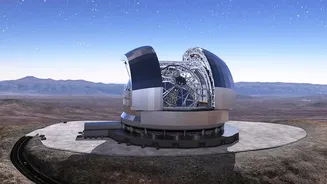
Modern astronomy is a science of big data. Surveys from telescopes like the Hubble Space Telescope and ground-based facilities generate massive datasets. For instance, the Vera C. Rubin Observatory in Chile is projected to capture about 20 terabytes of data every
single night. This creates a catalogue of billions of stars and galaxies that would be impossible for researchers to sift through manually. This is where AI excels. Machine learning algorithms can process and analyze these enormous volumes of information at speeds no human could ever match. Instead of spending months or years on tedious classification tasks, astronomers can deploy AI to do the heavy lifting, freeing them up to focus on interpretation and discovery.
A Cosmic Sorting Hat
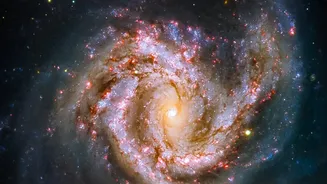
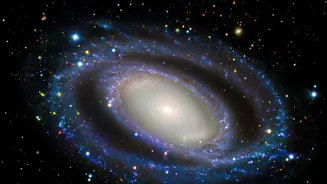
One of AI's most powerful applications in astronomy is classification. Just as an algorithm can be trained to tell the difference between a cat and a dog, it can learn to distinguish between different types of celestial objects. Astronomers use AI, particularly deep learning models called convolutional neural networks (CNNs), to sort galaxies by their shape—such as spiral, elliptical, or irregular. These models are often trained on vast catalogues of images that have been previously classified by humans, sometimes through citizen science projects like Galaxy Zoo. Once trained, the AI can classify hundreds of thousands of galaxies with high accuracy, a task that is not only time-consuming but also subject to human fatigue and inconsistency. Some AI models have achieved accuracy rates of over 97%, demonstrating their reliability in performing this fundamental astronomical task.
Finding the Fleeting and Faint
Many of the most exciting events in the cosmos are transient—they appear suddenly and fade quickly. These include supernovae (the explosive deaths of stars) and the faint dimming of a star that indicates a planet is passing in front of it (an exoplanet transit). Finding these fleeting signals in a constant stream of data is a classic 'needle in a haystack' problem. AI algorithms are perfectly suited for this, constantly scanning incoming data for anomalies. When a potential supernova or exoplanet candidate is detected, the system can automatically flag it for human astronomers to conduct follow-up observations. AI tools like ExoMiner and RAVEN have been used to validate hundreds of new exoplanets from data gathered by NASA's TESS and Kepler missions, including rare types of worlds that might have otherwise been missed.
Discovering the Unexpected
Perhaps the most thrilling use of AI in astronomy is not just finding what we expect, but discovering things we never knew existed. While some machine learning models are trained to look for specific patterns, others are designed for anomaly detection. These algorithms learn what 'normal' looks like in a vast dataset and then flag anything that deviates significantly. This can lead to the discovery of entirely new classes of celestial objects or phenomena that don't fit into our current understanding of the universe. In this sense, AI acts as a digital explorer, pointing out oddities in the data that merit a closer look. It moves beyond simple classification and becomes a tool for genuine, serendipitous discovery, pushing the boundaries of human knowledge by showing us where to look next.