



Why Venus? Earth's Toxic Twin
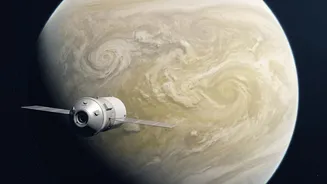
Venus is often called Earth's twin due to its similar size, mass, and density. But the similarities end there. It is the hottest planet in the solar system, with a surface temperature of over 460 degrees Celsius, hot enough to melt lead. Its atmosphere
is a crushing force, 90 times denser than Earth's, and is shrouded in thick clouds of sulfuric acid. Scientists believe Venus may have once been more like Earth, possibly with liquid water oceans, but suffered a runaway greenhouse effect. Understanding why our planetary twin had such a catastrophic evolution is a key scientific driver of the mission. The insights gained from studying Venus can provide crucial data for our own climate models and help us understand the fine line between a habitable world and a hellscape.
The Core Mission: Unlocking Atmospheric Secrets
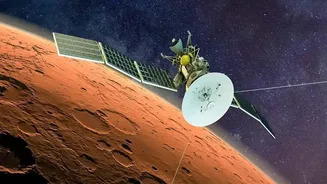
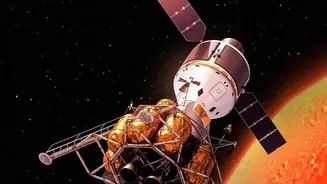
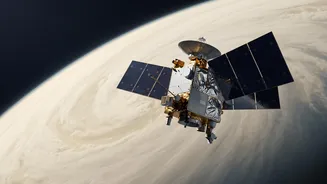
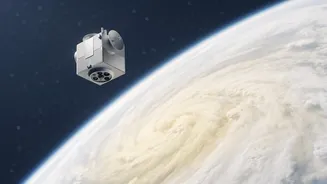
As the headline suggests, the primary focus of the Shukrayaan orbiter is a comprehensive investigation of the Venusian atmosphere. The mission, officially named the Venus Orbiter Mission (VOM), aims to study the atmosphere's structure, composition, and dynamics. A key objective is to understand the mysterious "super-rotation," where the atmosphere circles the planet in just four Earth days, far faster than the planet's own slow rotation. The orbiter will carry a suite of instruments designed to peer through the dense clouds, analyse the chemical makeup of the air, and investigate the interaction between the upper atmosphere and the constant stream of charged particles from the Sun, known as solar wind. This detailed atmospheric study is central to piecing together Venus's climatic history.
A Toolkit for a Hostile World
To achieve its ambitious goals, Shukrayaan will carry a payload of approximately 100 kg, comprising around 19 scientific instruments. A high-resolution Synthetic Aperture Radar (SAR) will be one of the key payloads, capable of piercing the thick cloud cover to map the planet's surface with unprecedented detail—at a resolution up to four times better than NASA's Magellan mission in the 1990s. Another first for Venus exploration will be a ground-penetrating radar designed to study the shallow subsurface. The mission also features significant international collaboration. Instruments developed with partners from Sweden, Russia, and Germany will be onboard. These include the Venusian Neutrals Analyser (VNA) from Sweden, which will study the interaction between solar wind and the planet's atmosphere.
The Road to Launch and Beyond
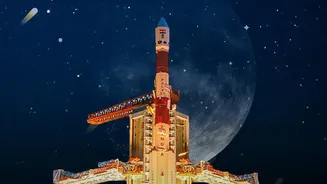
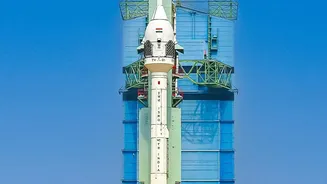
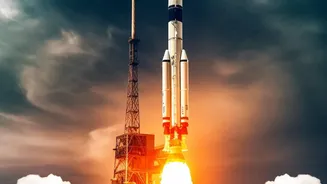
The Indian government formally approved the Shukrayaan mission on September 18, 2024, with a budget of approximately ₹1,236 crore. ISRO is targeting a launch date of March 29, 2028, aboard its most powerful rocket, the LVM-3. This launch window is chosen to ensure the spacecraft requires the minimum amount of fuel for its 112-day journey to Venus. Upon arrival on July 19, 2028, the orbiter will initially enter a large elliptical orbit. For the first time, ISRO will use a technique called aerobraking, using the friction of the upper atmosphere over several months to gradually lower its orbit to the planned 200 km by 600 km science orbit. From there, Shukrayaan is planned to operate for four to five years, sending back invaluable data that will place India at the forefront of planetary science.