



The Classic Re-entry Problem
For decades, entering a planet's atmosphere has relied on rigid heat shields. Think of the ceramic tiles on the Space Shuttle or the ablative shields on the Apollo capsules that burned away to dissipate heat. These systems work, but they have a fundamental
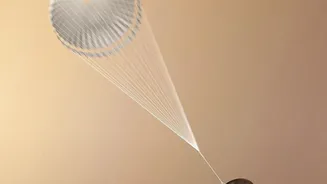
limitation: their size is constrained by the rocket's payload fairing, the nose cone that protects the spacecraft during launch. This size limit directly impacts how much mass you can land, especially in a thin atmosphere like Mars'. A smaller shield means less drag, requiring the spacecraft to survive higher temperatures and rely more on complex, propellant-heavy manoeuvres like retro-propulsion to slow down enough for a safe landing. This has historically limited where probes can land on Mars, restricting them to lower elevations where the atmosphere is thickest.
Enter the Inflatable Solution
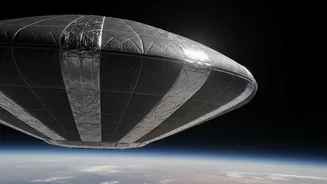
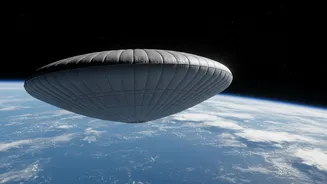
Inflatable atmospheric re-entry technology, or a Hypersonic Inflatable Aerodynamic Decelerator (HIAD), flips the script. Instead of a fixed, rigid shield, this system is packed down into a small volume for launch. Just before entering the atmosphere, it inflates like a giant, mushroom-shaped airbag. This approach, demonstrated successfully in NASA's Low-Earth Orbit Flight Test of an Inflatable Decelerator (LOFTID) mission, allows for a heat shield far larger than any rocket fairing could carry. The LOFTID vehicle, for example, was 6 meters (about 20 feet) across when inflated. This massive surface area creates significantly more drag, acting as a highly effective atmospheric brake.
How It Survives the Inferno
It might seem counterintuitive that something inflatable can withstand re-entry temperatures that can exceed 1600°C (nearly 3000°F). The secret lies in advanced materials and a clever multi-layer design. The inflatable structure itself is made of a series of pressurised rings, or tori, constructed from synthetic polymer fibres that are, by weight, stronger than steel. This provides the shape and rigidity needed to withstand immense drag forces. Protecting this structure is a flexible thermal protection system. The outermost layer is a woven ceramic fabric, often made of silicon carbide fibres, that can handle the extreme surface temperatures. Beneath this are layers of high-tech insulation that prevent heat from reaching the inflatable rings, and a gas barrier to block any hot atmospheric gases from getting through.
A Leap Forward in Safety and Capability
The primary safety improvement comes from starting the deceleration process higher up in the atmosphere. Because the inflatable shield creates so much drag, it can slow the spacecraft down more gradually and at higher altitudes where the air is thinner and heating is less intense. This reduces the peak thermal and mechanical loads on the vehicle. This gentler braking also reduces the reliance on complex and risky landing manoeuvres. Furthermore, the technology's flexibility makes it inherently more resilient than brittle ceramic tiles, which were a factor in the 2003 Columbia disaster. Beyond safety, the ability to deploy a large-diameter shield means spacecraft can carry much heavier payloads. This is a game-changer for future human missions to Mars, which will require landing massive habitats and life-support equipment. It also opens up the possibility of landing at higher-elevation scientific sites on Mars that were previously inaccessible.
The Future of Space Landings
The successful LOFTID test has paved the way for this technology to be used in a variety of future missions. One of the most promising applications is the recovery of reusable rocket components, such as the main engines of United Launch Alliance's Vulcan rocket. By equipping engine modules with an inflatable decelerator, companies can bring these valuable assets back to Earth for reuse, significantly lowering the cost of space access. The technology could also be used to return large cargo loads from the International Space Station or bring back samples from the Moon and Mars. As space agencies and commercial companies look to build a sustainable presence beyond Earth, inflatable heat shields are emerging as a critical enabling technology for safer, heavier, and more affordable missions.