

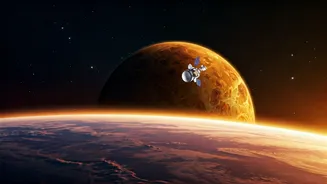



A Journey to Earth's 'Evil Twin'
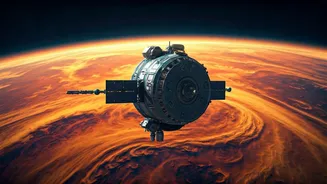
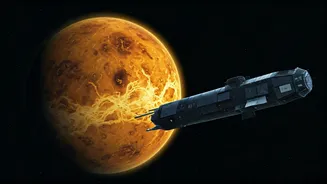
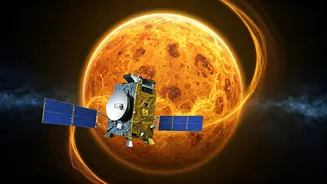
The Indian Space Research Organisation (ISRO) is setting its sights on our nearest planetary neighbour with the Shukrayaan-1 mission. Targeted for a 2028 launch, this orbiter mission represents India's next great leap in interplanetary exploration after
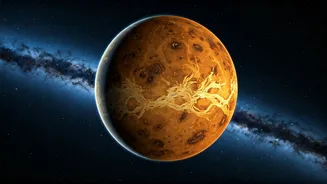
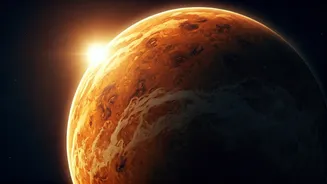
the successes of Mangalyaan (Mars Orbiter Mission) and Chandrayaan. Venus is often called Earth's 'twin' due to its similar size, mass, and composition. Yet, it is a world of extremes: surface temperatures hot enough to melt lead, a crushing atmosphere 90 times denser than Earth's, and clouds of sulfuric acid. Understanding why this twin took such a drastically different evolutionary path is the core scientific question driving the Shukrayaan mission and others like it. The mission will use advanced instruments, including a high-resolution synthetic aperture radar, to peer through the dense clouds and map the planet's surface and subsurface, something never done before.
The Ultimate Climate Cautionary Tale
Venus is the solar system's most potent example of a 'runaway greenhouse effect'. Scientists believe that billions of years ago, Venus may have been more like Earth, possibly with liquid water oceans. However, a massive buildup of greenhouse gases, likely from intense volcanic activity, trapped solar radiation. This created a catastrophic feedback loop: rising temperatures boiled the oceans, putting more water vapour (a potent greenhouse gas) into the atmosphere, which in turn trapped more heat. Eventually, the planet's entire water inventory was lost to space, leaving behind the toxic, superheated world we see today. By studying Venus, scientists can witness the end-game of climate change in its most extreme form. It serves as a natural laboratory to test and refine the climate models we use to predict Earth's future, helping us understand potential tipping points from which there may be no return.
Lessons for India's Atmosphere
For India, a nation uniquely vulnerable to climate change, the lessons from Venus are not merely academic. The country is already grappling with more frequent and intense heatwaves, erratic monsoons, and severe air pollution. The Shukrayaan mission's study of Venus's thick carbon dioxide atmosphere and sulfuric acid clouds holds direct relevance. For instance, understanding the behaviour of aerosols—tiny particles suspended in the atmosphere—is crucial. Venus's clouds are made of sulfuric acid droplets, a type of aerosol. Data on how these particles interact with radiation and influence weather patterns on a planetary scale can provide invaluable insights for understanding the impact of India's own significant aerosol pollution on the monsoon, temperature, and air quality. In essence, studying Venus helps us understand the complex atmospheric chemistry that could have profound impacts back on Earth.
A Symbol of Scientific Ambition
Beyond the direct climate science, the Shukrayaan mission is a powerful statement of India's scientific ambition and its commitment to tackling global challenges. As one of the world's most populous nations with a rapidly growing economy, India's role in the climate crisis—both as a contributor and a potential victim—is critical. Investing in fundamental science, such as planetary exploration, fosters innovation and builds the technical capacity needed for climate adaptation and mitigation. The mission will not only elevate India's standing in the global space community but also inspire a new generation of scientists, engineers, and policymakers. It demonstrates a forward-thinking approach: that the solutions to our most pressing problems here on Earth may sometimes be found by looking far beyond it.