



The Cosmic Missing Link
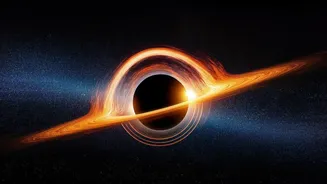
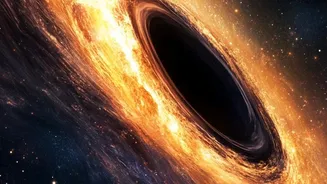
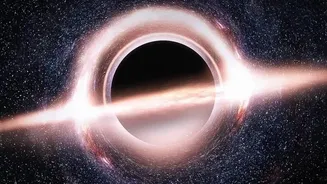
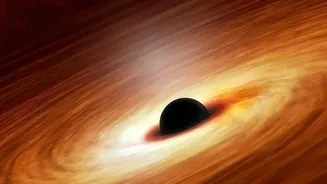
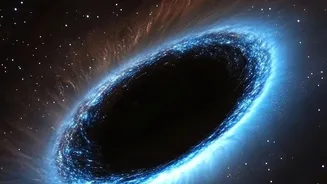
Astronomers have long known about two main classes of black holes. There are stellar-mass black holes, typically 5 to a few dozen times the mass of our Sun, formed from the collapse of giant stars. Then there are the supermassive black holes (SMBHs) found
at galactic centers, weighing millions or even billions of solar masses. For years, there was a glaring gap between these two extremes. Where were the 'intermediate-mass' black holes (IMBHs), those with masses ranging from hundreds to thousands of suns? Their apparent absence was a major puzzle, as they were the theoretical stepping stone needed to build a supermassive giant from smaller parts. Scientists believed they had to exist, but finding them proved incredibly difficult.
Listening to Spacetime Echoes
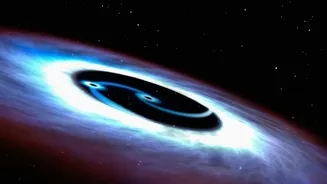
Enter gravitational waves. First predicted by Einstein, these are ripples in the very fabric of spacetime, generated by the most violent cosmic events. The Laser Interferometer Gravitational-wave Observatory (LIGO) and its international partners, Virgo and KAGRA, act like giant cosmic ears. They can detect the incredibly faint 'chirp' produced when two massive objects, like black holes, spiral into each other and merge. Recent catalogs of these gravitational wave events have revealed a flood of new discoveries, pushing the total number of confirmed detections to nearly 400. Among these signals are the first definitive proof of IMBHs in the act of merging, finally confirming their existence and opening a new window into their role in the cosmos.
The Hierarchical Growth Spurt
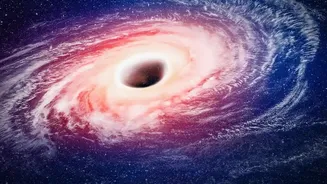
The detection of IMBH mergers provides powerful evidence for a process called 'hierarchical merging'. The idea is simple: black holes can grow by eating other black holes. Stellar-mass black holes, born from dead stars, can merge to form a slightly larger black hole. If this happens over and over, particularly in dense environments like globular clusters or the hearts of young galaxies, these objects can grow into IMBHs. New research suggests a significant percentage of observed black hole collisions involve 'second-generation' black holes—the products of previous mergers. These IMBHs then act as seeds. They can sink to the center of a galaxy and, through a series of further mergers with stars and other black holes, eventually grow into a supermassive behemoth.
Building a Galaxy from the Inside Out
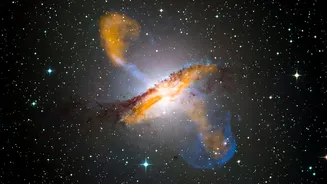
The growth of a supermassive black hole isn't a side story; it's central to the evolution of its entire host galaxy. The relationship is symbiotic. As the galaxy draws in gas and stars, it feeds the central black hole. In turn, the energy and radiation blasting out from the black hole's activity can regulate star formation across the galaxy, sometimes even shutting it down completely. By witnessing the mergers of IMBHs, we are essentially watching the construction of the 'engine' that will one day drive the evolution of a massive galaxy. These mergers were most common in the early universe, meaning gravitational waves are giving us a snapshot of the processes that built the cosmic structures we see today.
India's Ear on the Cosmos
This exciting frontier of astronomy is about to get a major boost from a new facility in India. The LIGO-India project, now under construction in Hingoli, Maharashtra, will add a fifth world-class detector to the global network. Having another detector, thousands of kilometers from the others, will dramatically improve the network's ability to pinpoint the exact location of a gravitational wave source in the sky. This is crucial for allowing conventional telescopes to quickly look for any light, such as an afterglow from a collision, associated with the event. With construction targeted for completion before 2030, LIGO-India will place the nation at the forefront of this revolutionary field, helping to solve the mysteries of black holes and galaxy formation.