







The Relentless Threat of a Vanishing Coastline
From West Bengal to Tamil Nadu, India's eastern coast is a dynamic but fragile environment. It is also on the front line of a severe battle against coastal erosion. Factors like rising sea levels, frequent and intense cyclones, and altered sediment flow
are causing the sea to swallow land at an alarming rate. For the millions living in coastal villages, this isn't an abstract environmental issue—it's a direct threat to their homes, agricultural lands, and sources of income. Events like the 1999 Odisha Super Cyclone and Cyclone Yaas in 2021 left behind trails of destruction, turning fertile fields saline and rendering communities more vulnerable than ever. This escalating crisis has highlighted the urgent need for a defence mechanism that is not only effective but also sustainable.
Nature's Coastal Guardians: The Mangrove Bio-Shield
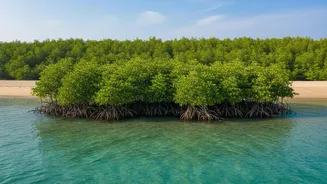
In the face of this challenge, the answer isn't being found in concrete sea walls alone, but in the dense, tangled roots of mangrove forests. Mangroves are unique trees and shrubs that thrive in the brackish water of coastal intertidal zones. For centuries, they have served as natural buffers, but their importance was often overlooked. Today, they are being recognised and replanted as 'bio-shields'—living barriers that protect the coast. Afforestation projects are underway across the eastern states, from the Sundarbans in West Bengal to the Krishna-Godavari delta in Andhra Pradesh and the Pichavaram wetlands in Tamil Nadu, all focused on restoring these vital ecosystems.
The Science of a Living Wall
How exactly does a forest stop the sea? The power of mangroves lies in their complex and dense root systems. These intricate networks act like a net, trapping and holding sediment that would otherwise be washed away by tides and currents. This process not only prevents erosion but can also help build up the shoreline over time. Furthermore, the thicket of roots and trunks is incredibly effective at dissipating wave energy. During a storm or cyclone, a healthy mangrove forest can reduce the force of storm surges, acting as a natural breakwater and shielding inland areas from the most destructive impacts of the waves.
From Theory to Practice: Success Stories on the Ground
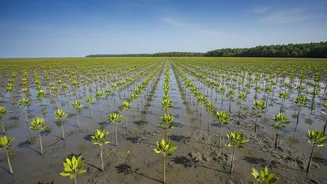
These are not just theoretical benefits. Community-led projects in Odisha are demonstrating the real-world impact. In coastal villages in Balasore and Kendrapara, women have been at the forefront of mangrove restoration, planting tens of thousands of saplings. These initiatives, often supported by government bodies and NGOs like the Action for Protection of Wild Animals (APOWA), have transformed degraded mudflats into nascent forests. In places like Sanghameswaram in Andhra Pradesh, memories of the devastating 1977 cyclone, which hit a coastline devoid of its mangrove shield, are fuelling a community-wide effort to restore the green barrier. These projects often combine scientific assessments of soil and water salinity with the invaluable traditional knowledge of local communities.
More Than Just a Barrier
The benefits of mangrove restoration extend far beyond erosion control. These ecosystems are biodiversity hotspots, serving as critical nursery grounds for countless species of fish, crabs, and shrimp. This directly supports the livelihoods of local fishing communities, who report better catches in areas with healthy mangroves. Moreover, mangroves are carbon sequestration powerhouses, capturing and storing vast amounts of carbon dioxide in their soil, a phenomenon known as 'blue carbon'. By restoring these forests, communities are not only protecting their homes but also creating economic opportunities and contributing to the global fight against climate change.
Challenges on the Path to a Greener Coast
The journey is not without its obstacles. Mangrove restoration is complex and requires more than just planting saplings. Success depends on getting the hydrology right; if tidal flows are blocked or unsuitable, plantations can fail. Choosing the correct native species for the specific salinity and soil conditions of a site is crucial for long-term survival. Furthermore, these projects require sustained community involvement and long-term monitoring, moving beyond initial plantation drives to ensure the saplings mature into a resilient forest. Ensuring these projects are scientifically sound and have strong community ownership is the key to scaling these efforts effectively along India's vast coastline.