





Building a Titan on Earth
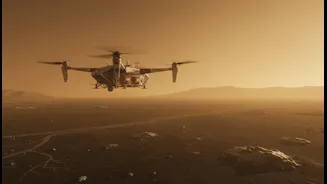
Before Dragonfly can fly on Titan, it must first prove it can survive the journey and the destination. A major step in reducing mission risk involves recreating Titan's bizarre environment right here on Earth. Titan’s atmosphere is about four times denser
than Earth's, its gravity is much lower, and temperatures plummet to a frigid -179 degrees Celsius. Engineers at the Johns Hopkins Applied Physics Laboratory (APL) have built special test chambers to mimic these conditions. One large chamber simulates the thermal environment, allowing the team to see how the rotorcraft heats and cools. Another can be chilled to Titan's extreme temperatures to test how components like sampling drills perform on super-hard water ice. These simulations are crucial for uncovering unexpected problems, such as the surprising risk of the lander overheating on a calm day, despite the intense cold.
Surviving the Shake and Seal
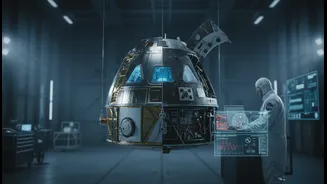
Every spacecraft must endure the violent vibrations of a rocket launch. To ensure Dragonfly’s lightweight but strong frame can handle the stress, engineers put the structure through intense “shake” tests. In May and June 2026, the team attached mass simulators in place of delicate instruments and vibrated the entire fuselage to see how it would respond to launch forces. This testing helps them understand how vibrations from the rotors themselves might interfere with other equipment during flight. More unusually, the team also performed a sealing test. Unlike most spacecraft designed for a vacuum, Dragonfly must keep Titan's dense atmosphere out. Engineers pressurized the structure to find any tiny gaps or cracks, a test one engineer noted was unlike any seen on other spacecraft. The results confirmed the structure was sealed exceptionally well, a key milestone for its survival.
Practicing Flight Without Leaving the Ground
How do you test a rotorcraft designed for Titan's unique combination of thick air and low gravity? You get creative. Engineers have used large wind tunnels, like the Transonic Dynamics Tunnel at NASA's Langley Research Center, to test the aerodynamics of Dragonfly's eight rotors. To simulate the dense atmosphere, they've even pumped special refrigerant gases into the tunnel to replicate the flow conditions the rotorcraft will experience. These tests allow the team to measure the performance, loads, and stresses on the rotors, putting them through worse conditions than they are expected to face on Titan. This extensive testing builds confidence that the design is robust and can handle the challenges of powered flight on another world.
Teaching a Drone to Think for Itself
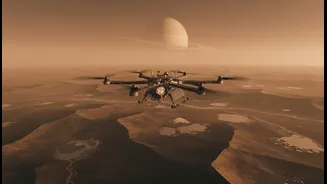
With a round-trip radio signal time of up to 2.5 hours, Dragonfly cannot be flown with a joystick from Earth. It must make its own decisions. A huge part of risk reduction is developing and testing its autonomous navigation system. The software needs to scout for safe landing zones, manage its flight path, and handle unexpected situations without human intervention. Mission planners have developed a series of software decision trees for various scenarios, telling the craft when to land immediately, hop to a safer spot, or return to its last location. While Titan's atmosphere is relatively stable with weak winds, this autonomy is critical for a mission that will perform dozens of flights to explore different locations, some up to 175 kilometers apart.
Assembling the Final Product
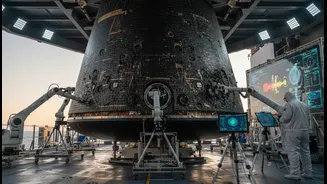
The final stage of risk reduction involves meticulously putting all the pieces together. Following the successful structural tests, the APL team delivered the main fuselage for integration in late June 2026. Now, engineers are carefully populating this structure with the mission's nervous system: the wiring harnesses, cables, and connectors that link everything together. This will be followed by the installation of the flight computers, electronics boxes, and the suite of scientific instruments, like the DraMS mass spectrometer, which will analyze the chemical composition of Titan's surface. This careful, step-by-step assembly and integration process ensures that every component, having been tested individually, also works as part of the complete system, readying Dragonfly for its launch no earlier than 2028.