




The Silent Killer in Your Pots
For container gardeners, watering is a delicate balance. Unlike plants in the ground, a potted plant’s roots are in a closed system. Excess water has nowhere to go, quickly saturating the soil and cutting off the oxygen supply to the roots. This leads
to root rot, a fungal condition that can quickly kill a healthy plant. The symptoms of overwatering—yellowing leaves, wilting, and leaf drop—can confusingly mimic those of underwatering, leading well-intentioned gardeners to add even more water and worsen the problem. The traditional "finger test" only measures moisture in the top few inches, often missing the dangerously waterlogged soil at the bottom of the pot. This is where many plant parents go wrong, watering based on a dry surface while the roots are drowning below.
What Exactly Is an IoT Soil Probe?
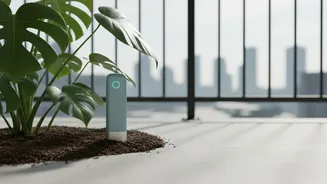
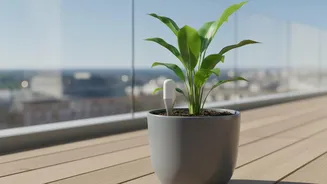
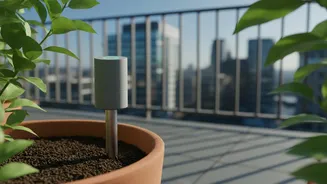
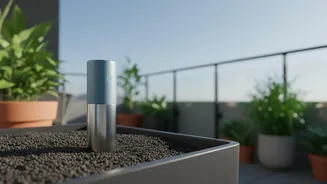
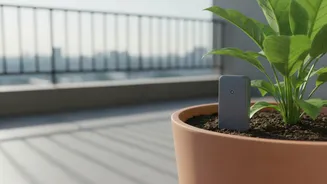
An IoT (Internet of Things) soil probe is a small, smart device you place in the soil of your potted plants. At its core, it's a sensor that constantly measures the moisture level around your plant's roots. Most modern probes are 'capacitive' sensors, which gauge moisture by measuring the soil's ability to store an electrical charge—wetter soil stores more charge. This method is more durable and accurate than older 'resistive' models that were prone to corrosion. The "IoT" part means the sensor is connected to the internet, usually via your home's Wi-Fi or Bluetooth. It sends its real-time data directly to an app on your smartphone, giving you an accurate, up-to-the-minute look at what’s happening in the pot.
Taking the Guesswork Out of Watering
The primary benefit of an IoT soil probe is its ability to provide precise, data-driven watering instructions. Instead of guessing, you can simply look at your phone. The companion app will typically show a clear moisture reading, often on a simple scale from 'Dry' to 'Wet'. Many apps allow you to input the type of plant you have, and they will then provide tailored recommendations and alerts. For example, it might tell you your succulent's soil is perfectly dry and ready for a drink, while your fern's soil is still ideally moist, preventing you from watering it unnecessarily. By providing this real-time data, the probe helps you avoid watering on a rigid schedule and instead respond to your plant's actual needs, effectively eliminating the risk of overwatering.
Beyond Moisture: A Deeper Look at Plant Health
While preventing overwatering is their main selling point, many advanced IoT probes offer a more holistic view of your plant's environment. More sophisticated models also measure soil temperature, ambient light levels, and even nutrient content by checking the soil's electrical conductivity (EC). This comprehensive data helps you understand the complete picture. For instance, you might discover that a plant you thought needed more water is actually getting too much direct afternoon sun, causing it to dry out too quickly. Or you might learn that the soil is depleted of nutrients, which explains why its growth has stalled. These insights empower you to make smarter decisions about not just watering, but also placement and feeding.
Choosing the Right Smart Probe for Your Balcony
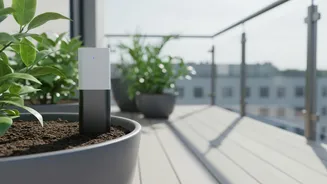
When selecting an IoT soil sensor, there are a few key features to consider for balcony gardening. First, check its connectivity—Wi-Fi models offer greater range, which is useful on a larger balcony, while Bluetooth is fine for plants kept closer to your living space. Battery life is also crucial; look for devices that can last for at least a year on a single set of batteries. The quality of the companion app is just as important as the hardware. A good app will have a large database of plants, provide clear and actionable alerts, and present the data in an easy-to-understand format. Finally, consider the probe length. For the typical pots used on a balcony, a standard-length probe is usually sufficient, but some brands offer different lengths for deeper containers.