


The Universe’s Missing Link
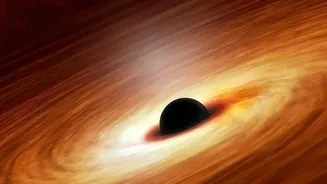
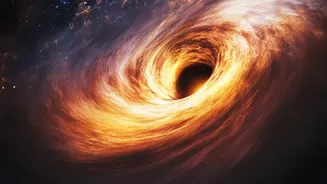
In the cosmic zoo of black holes, astronomers have long been familiar with two main types: the smaller stellar-mass black holes, which are typically 5 to 50 times the mass of our sun, and the supermassive giants that lurk at the hearts of galaxies, weighing
millions or even billions of solar masses. But for decades, there was a mysterious gap. Where were the black holes in between? These are the intermediate-mass black holes (IMBHs), with masses ranging from 100 to 100,000 times that of the sun. Their existence was predicted by theory, but finding direct evidence proved incredibly difficult, earning them the nickname of the “missing link” in black hole evolution.
Hearing Spacetime Tremble
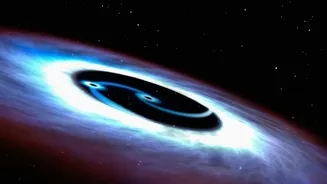
Detecting IMBHs is challenging because they are not as active or obvious as their supermassive cousins. The breakthrough came not from seeing, but from listening. When two black holes spiral into each other and merge, they create a cataclysmic event that releases an enormous amount of energy in the form of gravitational waves — ripples in spacetime itself. Observatories like LIGO in the United States, Virgo in Italy, and KAGRA in Japan are designed to detect these incredibly faint tremors. An event named GW190521 was a landmark detection, where two black holes of about 85 and 66 solar masses merged to form a new black hole of 142 solar masses. This remnant fell squarely into the IMBH category, providing the first clear, direct evidence that these objects truly exist.
Clues from a Cosmic Collision
The gravitational waves from these mergers are more than just a confirmation of existence; they are treasure troves of information. The precise shape of the wave—its frequency, amplitude, and how it changes over the brief moment of the merger—tells astrophysicists about the properties of the colliding objects. Scientists can determine their masses and even their spins. The spin is particularly revealing. A black hole formed from a single star’s collapse is expected to have a low spin. However, when two black holes merge, the resulting object spins very fast. By observing the spins of merging black holes, scientists can tell if they are seeing a first-generation object or one that is the product of a previous collision, a process called hierarchical merging.
Seeds of Galactic Giants
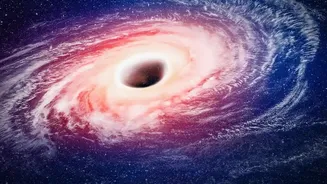
This leads to the most profound implication of IMBH collisions: understanding the origin of supermassive black holes. How did the behemoths at the center of galaxies like our own Milky Way get so big? One leading theory is that they grew from smaller “seeds” in the early universe. IMBHs are the prime candidates for these seeds. It is theorised that in the dense, chaotic environments of the early cosmos, smaller black holes repeatedly merged, growing larger and larger in a stepwise fashion. Each IMBH collision detected by LIGO and its partners is essentially a live-action demonstration of this growth process. These events often occur far away, meaning the light and gravitational waves have traveled for billions of years to reach us, giving us a direct snapshot of processes that were common in the young universe.