



An Eerily Glowing Spectacle
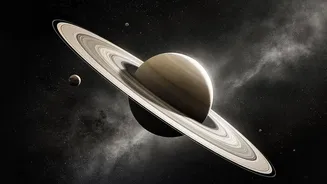
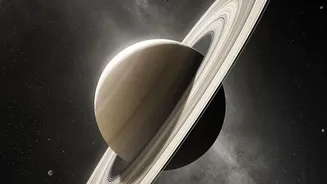
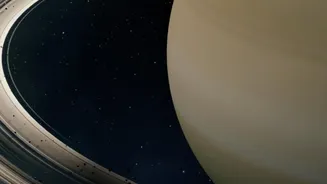
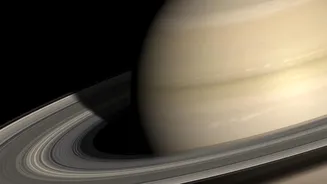
The first thing you notice in the James Webb Space Telescope’s (JWST) recent portraits of Saturn is how different it looks. The planet itself appears unusually dark, almost shadowy, while its famous rings glow with a brilliant, ethereal light. This isn't
a filter for dramatic effect; it’s a result of how JWST sees the universe. The telescope observes in infrared light, which is invisible to the human eye. Saturn’s atmosphere is rich in methane gas, which absorbs nearly all the sunlight that hits it at the specific infrared wavelengths JWST uses. This makes the planet’s signature stripes disappear, rendering its disk dark. The rings, however, are made mostly of water ice particles, which are incredibly reflective in the infrared spectrum. As a result, they outshine the planet, providing scientists with an unprecedentedly clear view of their structure and composition.
Unveiling Atmospheric Surprises
With the planet darkened, Webb has revealed unexpected features in Saturn's upper atmosphere that were previously hidden. Large, diffuse structures have been observed in the northern hemisphere that don't follow the planet's typical lines of latitude. This indicates complex processes at high altitudes, possibly related to seasonal changes. It’s currently summer in Saturn’s northern hemisphere, but the pole itself appears unusually dark. Scientists speculate this could be due to an unknown process affecting polar aerosols. Some of the most groundbreaking observations relate to Saturn's auroras. Webb has shown that these northern lights actively heat the upper atmosphere, which in turn drives powerful winds. These winds generate electrical currents that feed back into the auroras, creating a self-sustaining cycle that could explain long-puzzling variations in what was thought to be Saturn's rotation rate.
The Mystery of 'Ring Rain'
For decades, scientists have known that Saturn's rings are not permanent. An enormous amount of icy particles—enough to fill an Olympic-sized swimming pool daily—is constantly raining down from the innermost rings into the planet's upper atmosphere. This phenomenon, known as 'ring rain,' heats Saturn’s ionosphere. Data from the Cassini probe confirmed this influx, but the exact rate and its long-term effects remained unclear. JWST's observations are crucial for understanding this process. By studying the seasonal variations in the ring rain, scientists hope to create a forecast for the rings' ultimate fate. Current estimates suggest the rings could vanish in as little as 100 million years, a surprisingly short lifespan in cosmic terms. Webb's data will help refine these models, telling us whether we are living in a special time to witness Saturn's most famous feature before it disappears.
Faint Rings and Feeding Moons
While the main rings are bright, Saturn also hosts fainter, more diffuse rings that are difficult to study. Webb's high sensitivity is designed to probe these elusive structures, like the G ring and the vast E ring. Recent observations have confirmed the source of the E ring: the moon Enceladus. JWST captured stunning images of a massive plume of water vapor and ice particles jetting from Enceladus’s southern pole, directly feeding material into the ring. The telescope's mission also includes searching for new, faint moons hiding within the ring system. Discovering these small bodies and mapping their orbits can provide a more complete picture of the Saturnian system's history, helping scientists understand how the rings may have formed—whether from a shattered moon or a captured comet—and how they have evolved over time.