





The Problem With All-or-Nothing Fitness
For decades, the prevailing wisdom was that for exercise to count, it had to be a sustained, sweat-drenched effort lasting at least 30 to 60 minutes. This created a powerful mental hurdle. If you couldn't block out a significant chunk of your day, it felt
pointless to even start. The result? Millions of Americans, short on time but not intention, end up doing nothing at all. This is where the concept of micro-workouts, sometimes called “exercise snacks,” comes in. It’s a fitness philosophy built for the reality of modern life, challenging the idea that longer is always better. The goal is to reframe exercise from a single, monolithic event into small, distributed moments of activity throughout your day.
The Science of 'Exercise Snacking'
You might be skeptical. Can five minutes of movement really compare to an hour on the treadmill? While a single five-minute burst won't build the same endurance as a 10-mile run, the cumulative benefits are surprisingly potent. Research has shown that short, intense bursts of activity can be remarkably effective. Studies suggest these “exercise snacks” can improve blood sugar control after meals, boost cardiovascular health, and enhance overall metabolic function. The key is intensity and consistency. By frequently breaking up long periods of sitting, you’re repeatedly signaling your muscles and metabolism to switch on. Think of it less like eating one giant meal a day and more like having several healthy snacks—both can lead to a positive outcome, but one is far easier to fit into a busy schedule.
Your 5-Minute Office Reboot
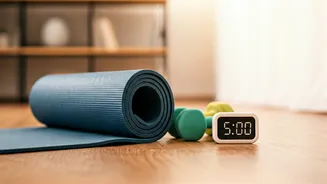
Your desk job is no longer an excuse. When you feel that afternoon slump coming on, instead of reaching for another coffee, try this quick circuit. You don't need special clothes or equipment, just a few feet of space. Set a timer for five minutes and move through these exercises: 1. **Chair Squats (60 seconds):** Stand up from your chair and lower yourself back down until you barely touch the seat, then stand back up. Keep your chest up and core engaged. 2. **Desk Push-Ups (60 seconds):** Place your hands on the edge of a sturdy desk, wider than your shoulders. Walk your feet back and perform a push-up. The more horizontal your body, the harder it is. 3. **Walking Lunges (60 seconds):** If you have a hallway or a bit of space, do walking lunges for one minute. 4. **High Knees (60 seconds):** March in place, bringing your knees up to waist height. 5. **Torso Twists (60 seconds):** Stand with feet shoulder-width apart and twist your upper body from side to side.
The At-Home Power Circuit
Use those small pockets of time at home—while waiting for water to boil, during commercial breaks, or right when you wake up. This five-minute routine requires no equipment and works the entire body. 1. **Jumping Jacks (60 seconds):** The classic cardio move. It gets your heart rate up immediately. 2. **Bodyweight Squats (60 seconds):** Focus on good form, keeping your back straight and going as low as you comfortably can. 3. **Plank (60 seconds):** Hold a plank on your forearms or hands. Keep your body in a straight line from head to heels. If a minute is too long, hold for 20 seconds, rest for 10, and repeat. 4. **Mountain Climbers (60 seconds):** From a plank position, alternate bringing your knees toward your chest quickly. 5. **Glute Bridges (60 seconds):** Lie on your back with knees bent and feet flat on the floor. Lift your hips toward the ceiling, squeeze your glutes, and lower back down.
How to Make It a Habit
The secret to making micro-workouts stick is to lower the barrier to entry so much that it feels harder *not* to do them. Don't think of it as scheduling a workout. Instead, 'tether' the habit to something you already do. For example: every time you get up to get water, do 20 squats. Every time you finish a Zoom call, do a one-minute plank. After you use the restroom, do 10 push-ups against the wall. The goal isn't to be perfect; it's to be consistent. Some days you might fit in three micro-workouts. Other days, just one. All of it counts. By accumulating these small bursts of activity, you're not just improving your physical health—you're building a sustainable, lifelong habit of movement.