


Seeing the Unseen
For most of astronomical history, studying distant planets was a feat of indirect detection. Scientists could find exoplanets by observing the slight dimming of a star as a planet passed in front of it, or the subtle gravitational wobble a planet induces
on its star. These methods confirmed their existence, size, and orbit, but told us very little about the planets themselves. They were ghosts in the machine—present, but unseen. The challenge was to move beyond mere detection to characterisation. What are these worlds made of? What are their climates like? Answering these questions required a new way of seeing, one that could parse the faint light from these faraway systems for clues about their atmospheres.
The Power of Infrared Light
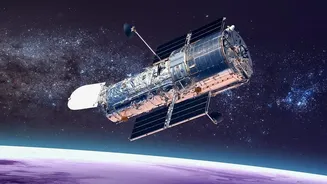
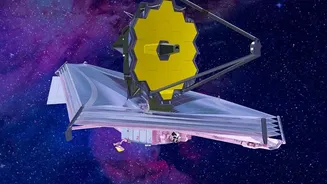
The breakthrough came with advanced infrared observatories, most notably the James Webb Space Telescope (JWST). Unlike visible light, which is easily scattered by cosmic dust and clouds, infrared radiation passes through these obstacles more freely. This allows astronomers to peer into regions of space that are otherwise obscured. More importantly, infrared is the language of heat. Cooler objects, like planets, emit much of their energy in the infrared spectrum. By tuning into these wavelengths, telescopes can gather information about a planet's temperature, a fundamental driver of weather. This capability allows scientists to not only see through atmospheric haze but also to directly measure the thermal energy radiating from these distant worlds.
Decoding an Alien Weather Report
The primary technique for this cosmic meteorology is called transmission spectroscopy. As an exoplanet transits, or passes in front of its host star, a tiny fraction of the starlight filters through the planet's atmosphere. The molecules in that atmosphere absorb light at very specific infrared wavelengths. This creates a unique chemical "fingerprint" or barcode in the light that reaches the telescope. By analysing which wavelengths of light are missing, scientists can deduce the chemical composition of the atmosphere—detecting elements like water, methane, and carbon dioxide. This technique provides the foundational data needed to understand the building blocks of an alien world's climate.
Case Study: Wild Weather on Hot Jupiters
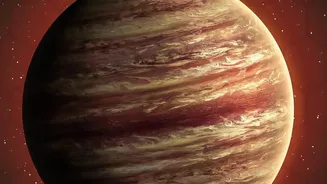
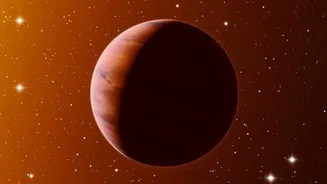
Nowhere are these new capabilities more dramatically demonstrated than in the study of 'hot Jupiters'. These are gas giants orbiting perilously close to their stars, often tidally locked with one side perpetually facing the star's blistering heat and the other in permanent darkness. Recent JWST observations of a hot Jupiter named WASP-94A b revealed a striking planet-wide weather cycle. The data suggests clouds form on the cooler, dark side of the planet and are then blown by powerful winds toward the dayside, where they evaporate in the intense heat. This creates a world with cloudy mornings and clear evenings. On other extreme worlds, conditions are even more bizarre, with evidence pointing to clouds made of silicate minerals—effectively raining molten glass—and winds blasting at over 15,000 miles per hour.
Mapping an Entire Planet's Climate
Beyond single snapshots, infrared telescopes can create rudimentary weather maps of these planets. By using a method called phase curve analysis, astronomers observe a planet continuously as it completes its orbit. This allows them to measure the total light from the system, capturing how the planet's brightness changes as it shows different faces—from its fully illuminated dayside to its dark nightside. These subtle shifts in infrared light reveal temperature differences across the planet's surface. On WASP-121 b, for instance, this technique showed that the evening side is hotter than the morning side, consistent with powerful winds dragging heat from the dayside around the planet. Such observations move beyond just identifying atmospheric chemicals to actually mapping the dynamics of a global weather system in action.