



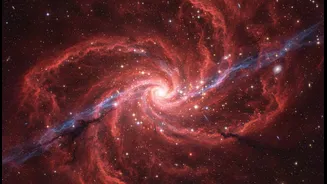


The Pillars of Creation: A Stellar Nursery
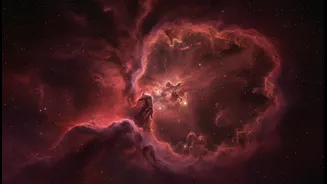
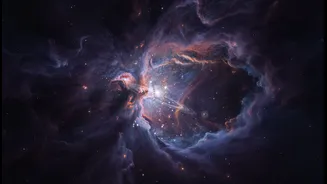
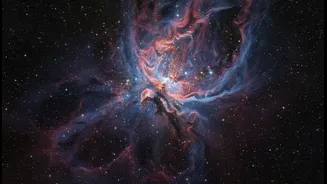
Arguably the most famous image Hubble has ever produced is the 'Pillars of Creation.' First captured in 1995 and revisited since, this portrait shows towering columns of interstellar gas and dust within the Eagle Nebula, some 7,000 light-years away. These
are not static celestial sculptures; they are an active star-forming region, a cosmic nursery where new stars are born within the dense, wispy columns. The pillars themselves are immense, stretching for roughly four to five light-years. While intense radiation from young, nearby stars is slowly eroding them, their ethereal beauty cemented Hubble's role not just as a scientific instrument but as an artist, revealing the universe's breathtaking creative power.
The Hubble Ultra-Deep Field: A Window to the Past
If the Pillars showed us beauty, the Hubble Ultra-Deep Field, released in 2004, showed us scale in a way humanity had never before grasped. Hubble stared at a tiny, seemingly empty patch of sky in the Fornax constellation for 11.3 days, collecting faint light that had traveled for billions of years. The result was staggering: an image containing nearly 10,000 galaxies. Each speck, each smudge of light, represented an entire galaxy of stars. Because the light took so long to reach us, the image is a time capsule, showing galaxies as they were when the universe was just 800 million years old. It fundamentally changed our perception of the cosmos, proving it was far more crowded and vast than we ever imagined.
Cosmic Reef: A Tale of Two Nebulae
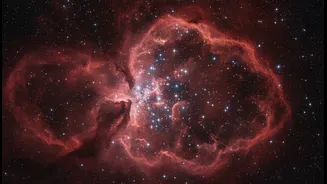
To celebrate its 30th anniversary in 2020, Hubble captured an image nicknamed the 'Cosmic Reef.' It depicts a massive star-forming region in the Large Magellanic Cloud, a satellite galaxy of our own Milky Way. The image showcases two distinct nebulae: a huge, sparkling red nebula (NGC 2014) and its smaller, brilliant blue neighbor (NGC 2020). The red nebula is shaped by the powerful winds of massive stars within it, which are 10 to 20 times more massive than our sun. The blue nebula, in contrast, was likely formed by a single, giant star that shed its outer layers. This portrait is a perfect example of Hubble’s ability to capture the dynamic and often violent processes that shape the universe, painting them in spectacular colour.
A Modern Sparkler: A Glimpse of the Early Universe
Even in 2026, Hubble continues to deliver awe-inspiring views. A recent image released to mark the United States' 250th anniversary showcases a globular cluster named NGC 6426. The image, twinkling with red, white, and blue stars, is more than just festive. This cluster is about 13 billion years old, making it one of the oldest in the Milky Way and nearly as ancient as the universe itself. By studying such ancient star systems, which contain elements from the early universe, astronomers can piece together how our own galaxy formed and evolved. These recent observations prove that even after decades of service, Hubble remains a critical tool for unraveling cosmic history.