




A Window into the Solar System's Past
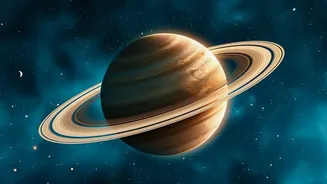
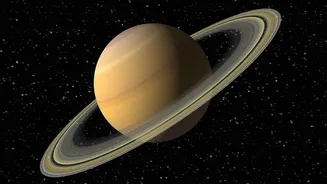
One of the most compelling reasons to study Saturn’s rings is that they serve as a model for how planets and moons form. The rings are essentially an astrophysical disk, similar to the protoplanetary disks of gas and dust that coalesce to form planets around
young stars. By observing the way particles clump together, interact with tiny 'moonlets', and are sculpted by the gravity of larger moons, scientists can gain insights into the chaotic and complex process of planetary formation. The intricate structures, waves, and gaps in the rings provide a physical record of gravitational forces at work, offering a tangible example of processes that happened billions of years ago across the entire solar system.
The Great Debate: How Old Are They?
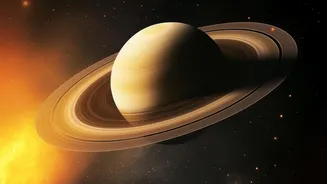
A major mystery that keeps scientists intrigued is the age of the rings. For a long time, it was assumed they were ancient, forming alongside Saturn 4.5 billion years ago. However, data from NASA's Cassini mission suggested they might be surprisingly young, perhaps only 10 million to 100 million years old. This theory is based on their brightness; the rings are made of 99.8% pure water ice, and scientists expected them to be much darker from billions of years of pollution by micrometeoroid dust. Some recent simulations in 2022 and 2023 propose the rings formed from the destruction of an icy moon that strayed too close to Saturn, or from the collision of two moons. This violent event would have happened in the relatively recent past, when dinosaurs roamed the Earth. However, the debate is far from settled, with other recent models suggesting the rings could indeed be ancient, renewing the controversy and fueling further research.
A Dynamic and Ever-Changing System
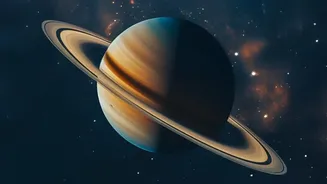
Far from being a static feature, Saturn's rings are a scene of constant activity. The Cassini spacecraft revealed a host of dynamic processes, from propeller-like features created by unseen moonlets to towering vertical structures that cast long shadows across the ring plane. The mission also watched moons interacting with the rings, some stealing particles and others, like the icy Enceladus, actively supplying material to the faint E-ring through its plumes. This constant flux shows that the rings are not a relic, but a living part of the Saturnian system. Furthermore, they are not permanent. A phenomenon known as 'ring rain' is pulling material from the rings into Saturn's atmosphere at a rate of thousands of kilograms per second. At this rate, the iconic rings could disappear entirely within the next 100 to 300 million years, making it a priority to study them while we can.
The Mysterious 'Ring Rain'
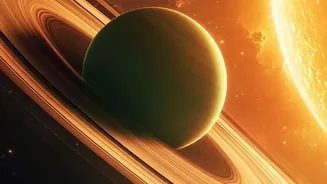
One of the most surprising discoveries from Cassini's final orbits was the composition of the material raining down onto the planet. While the rings are known to be almost entirely water ice, the 'ring rain' was found to be a complex cocktail of chemicals. Water made up only about 24% of the material, with the rest composed of methane, carbon monoxide, ammonia, and various organic molecules. This was a major surprise and has left scientists with a new puzzle to solve: why is the chemical composition of the rain so different from its source? Understanding this process is crucial as it directly affects Saturn's upper atmosphere, influencing its composition and temperature. This interaction between a planet and its ring system is a significant area of study, offering new insights into planetary climate and evolution.