


A Ghost's 11-Billion-Year Journey
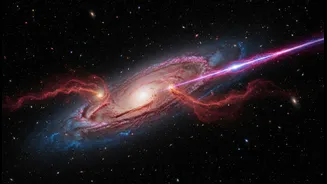
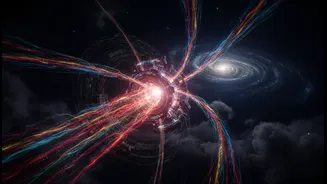
On September 22, 2021, a single, incredibly energetic particle ended its 11-billion-year journey by striking an atom deep within the Antarctic ice. This was no ordinary particle. It was a high-energy neutrino, detected by the massive IceCube Neutrino
Observatory. Neutrinos are fundamental particles with almost no mass and no electric charge, meaning they rarely interact with anything. Billions of them pass through your body every second, completely unnoticed. This elusiveness makes them fascinating messengers from the cosmos, as they travel in a straight line from their source, undeflected by magnetic fields. But it also makes them incredibly difficult to detect and trace. The 2021 event, catalogued as IC210922A, was special because its energy was more than 100 times greater than what can be generated in our most powerful particle accelerators. An international team of astronomers immediately began a cosmic detective story to find its source.
The Evidence: Unmasking the Shadow Blaster
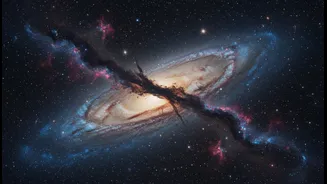
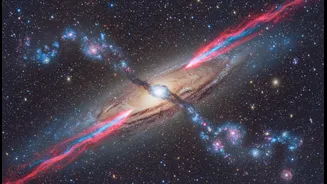
The prime suspects for creating such powerful neutrinos have long been blazars—galaxies with supermassive black holes at their cores that shoot jets of particles directly at Earth. However, when telescopes looked in the direction from which IC210922A arrived, they found no such object. Instead, they found something just as remarkable: a very distant, dusty galaxy. Because it was so obscured by its own dust, making it invisible in normal light but intensely bright in other wavelengths, astronomers nicknamed it the “Shadow Blaster”. The key piece of evidence was what wasn't there: the tell-tale X-ray emissions of an active black hole. Instead, observations pointed to something else entirely: a furious storm of star formation packed into a dense, gassy core. The discovery was aided by a lucky coincidence of cosmic alignment. A closer, massive galaxy sits directly in front of the Shadow Blaster, and its immense gravity bends and magnifies the light from behind it—a phenomenon known as gravitational lensing. This cosmic magnifying glass allowed astronomers to get a detailed look at what would otherwise be too faint to study, revealing a star-forming engine powerful enough to create high-energy neutrinos.
The Opportunity: A New Cosmic Engine
The identification of the Shadow Blaster as a neutrino source represents a major shift in our understanding of the universe's most extreme events. If confirmed, it would be the first time an individual dusty, star-forming galaxy has been directly linked to a high-energy neutrino. This suggests that supermassive black holes are not the only cosmic accelerators capable of this feat. Vigorous starburst galaxies, where countless stars are born and die in a compact region, may be a whole new class of neutrino factories. This is particularly exciting because galaxies like the Shadow Blaster were far more common in the early universe, during an era known as the “Cosmic Noon” around 10 billion years ago. These ancient, dusty galaxies could be the missing source population that scientists have been searching for to explain the total background level of high-energy neutrinos that observatories like IceCube detect. It opens a new chapter for multi-messenger astronomy, where information from neutrinos, light, and gravitational waves are combined to get a complete picture of cosmic events.
The Limits: One Ghost Is Not a Haunting
While the evidence is compelling, it is important to maintain scientific perspective. The link between the neutrino and the Shadow Blaster is based on a single detection event. In science, one data point is a clue, not a conclusion. To confirm that starburst galaxies are indeed a major source of high-energy neutrinos, astronomers will need to detect more of these associations. This is a significant challenge. Neutrino observatories must be enormous—IceCube uses a cubic kilometre of ice—just to catch a few dozen of these high-energy particles per year. Furthermore, the Shadow Blaster itself was only observable in such detail because of the rare gravitational lensing effect. Thousands of other potential sources remain hidden behind curtains of cosmic dust, far away and faint. The journey to fully understanding the origins of cosmic neutrinos is far from over. Each detection provides a valuable breadcrumb, but building a complete map of these cosmic accelerators will require patience, technological advancement, and perhaps a few more lucky alignments in the sky.