

The Solar System's Icy Frontier
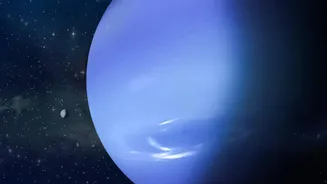
Far beyond the orbit of the major planets lies the Kuiper Belt, a doughnut-shaped ring of icy bodies left over from the formation of the solar system 4.5 billion years ago. This region, starting near Neptune's orbit, is a repository of some of the most
primitive materials available for study. It’s a realm of dwarf planets, comets, and countless smaller objects, all preserved in a deep freeze. For scientists, it’s a treasure trove of clues about how our planetary system was born. However, visiting these objects directly is incredibly difficult; it takes years for spacecraft to travel that far, making sample return missions almost impossible with current technology. This is why scientists have turned to an ingenious alternative: studying the dust that comes to us.
Reading A Story In Dust
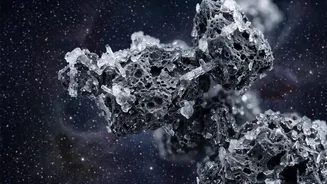
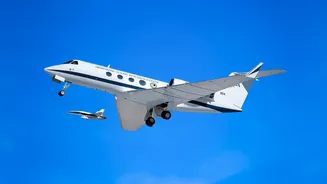
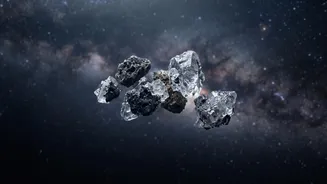
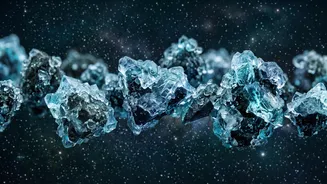
An estimated 5,200 metric tons of cosmic dust rain down on Earth every year. A small fraction of this originates from the Kuiper Belt. A team of scientists, led by NASA's Lindsay Keller, examined twelve microscopic dust grains that were collected from Earth's stratosphere by high-flying aircraft. They were able to confirm the particles' distant origin by analysing the radiation tracks, or scars, left by solar energetic particles during their long journey through space. These tiny specks, far from being simple debris, are messengers carrying chemical secrets from the edge of the solar system. The study, published in the journal 'Science Advances', focused on what these grains could tell us about their parent bodies.
The Chemical Signature of 'Heavy' Water
The analysis revealed something remarkable. The dust grains contained minerals like saponite and serpentine, which only form when liquid water interacts with rock. This means that at some point in the distant past, liquid water must have existed inside the objects from which this dust originated. While the Kuiper Belt is frozen solid today, heat from radioactive decay or ancient collisions could have melted ice in the interiors of these bodies long ago. More importantly, the oxygen locked within these minerals was different. It was unusually rich in heavier oxygen isotopes, versions of the element with more neutrons. This unique chemical fingerprint suggests the water that formed these minerals came from a source quite unlike the water found closer to the Sun, including on Earth.
What is a 'Water Reservoir'?
The term 'reservoir' in this context doesn't mean a subterranean ocean of the kind suspected on moons like Europa or Enceladus. Instead, the findings provide compelling evidence for a massive, regional source of 'heavy' water that remained largely isolated from the materials that mixed and mingled in the inner solar system. This reservoir would consist of the collective water ice contained within a large population of Kuiper Belt Objects. The discovery supports a long-held theory that the outer solar system contained a distinct type of water, one that preserved a more primordial chemical signature from the cloud of gas and dust that birthed our Sun and planets. The unique oxygen signature may have been created by ultraviolet light breaking apart certain molecules in the early solar nebula.
Why This Discovery Matters
This finding has profound implications for our understanding of how the solar system, and potentially life itself, came to be. Water is a key ingredient for life as we know it, and understanding its distribution and different 'flavours' is crucial. The theory that Earth's water was delivered by comets and asteroids from the outer solar system is common, but this study suggests the story is more complex. The water in the Kuiper Belt seems to have stayed put, largely cut off from the rest of the system. This pristine reservoir gives scientists a rare window into the original chemistry of the outer solar system, a control group against which we can compare the materials that formed our own world. It helps us piece together the puzzle of how planets formed and why Earth ended up as a life-sustaining, water-rich oasis in the cosmos.