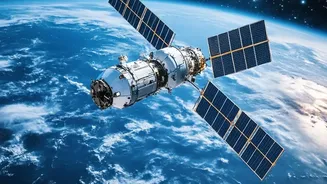







A Lifeline from the Stars
When Russian forces invaded in 2022, they targeted Ukraine's traditional communication infrastructure. In response, SpaceX activated its Starlink satellite internet network over the country, shipping in thousands of portable user terminals. These devices,
roughly the size of a pizza box, connect to a vast constellation of satellites in low-Earth orbit, providing high-speed internet access independent of ground-based cables. For a country under attack, the effect was immediate and profound. It allowed the government, military, and emergency services to stay online when other systems failed. One Ukrainian commander noted in 2022 that without Starlink, they might have already lost the war, highlighting its foundational importance to command, control, and intelligence operations.
The Digital Backbone of Modern Warfare
Starlink's most visible impact has been on the battlefield. The system's low latency and high-speed connection are essential for Ukraine's drone-centric warfare. Operators use Starlink to control unmanned aerial vehicles (UAVs) and receive real-time video feeds from deep behind enemy lines, a task impossible with traditional radio links that are more vulnerable to jamming. This capability has enabled everything from reconnaissance missions to precise strikes on Russian targets. Ukraine uses both the commercial Starlink service and Starshield, a more secure, military-grade version developed for government use, to maintain stable communications in electronically contested environments.
More Than Just a Military Tool
Beyond its military applications, Starlink has been vital for Ukrainian society. It has kept hospitals, businesses, and government agencies connected, ensuring the continuity of essential services amidst persistent Russian attacks on infrastructure. For ordinary citizens in areas with destroyed cell towers and fiber optic lines, Starlink terminals provided a crucial link to the outside world, allowing them to contact family and access information. This has made the network an integral part of Ukraine's national resilience, not just its defense strategy. The initial rollout was funded by SpaceX and private donations, but the U.S. Department of Defense has since taken over the costs through formal contracts, recognizing satellite communications as a vital layer of Ukraine's infrastructure.
A Complicated and Challenging Reliance
Dependence on Starlink has not been without its challenges. Russia has actively tried to disrupt the service through electronic warfare, employing systems like the 'Volna Kupol Garant' to jam satellite signals. This has created a constant cat-and-mouse game, with SpaceX hardening its software to counter Russian attacks. Further complexity arises from the network's ownership. Recent service disruptions and newly imposed speed limits on fast-moving drones have caused alarm in Kyiv, interrupting critical missions. These events, reportedly linked to U.S. government decisions, have highlighted the vulnerability of relying on a system that Ukraine does not ultimately control, sparking a search for alternative communication platforms.
The Future of a Wartime Partnership
Recent service restrictions, which reportedly affected drones moving faster than 160 km/h, have hampered Ukraine's ability to use some of its most effective systems, including interceptor drones used against Russian attacks. While some services were restored, the incident left Ukrainian officials uneasy and acutely aware of their dependency. The episode underscores a new reality in modern conflict: the pivotal role of private technology companies in national security. Europe has acknowledged its own dependence on U.S. space capabilities and is exploring long-term alternatives, though none can currently match what Starlink provides. For Ukraine, the reliance is a strategic necessity, but one that comes with inherent risks and uncertainties tied to corporate decisions and international politics.