






What is a Superhabitable Planet?
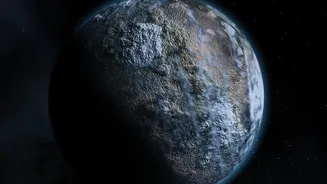
A superhabitable planet is a hypothetical world with conditions more suitable for the emergence and evolution of life than Earth. The concept, first detailed by scientists René Heller and John Armstrong in 2014, challenges our Earth-centric view of the universe.
They argue that while Earth is clearly habitable (we are the proof), it may not represent the optimal environment for life in the cosmos. A superhabitable world wouldn't just be able to support life; it would be capable of supporting a greater amount of biomass and biodiversity than our own planet. This shifts the focus from finding a mirror image of Earth to identifying planets with a specific set of superior characteristics.
The Recipe for a Better World
So, what ingredients make a planet 'super'? Scientists have a checklist. First, they look at the star. Instead of a sun-like G-dwarf star, a slightly smaller and cooler K-dwarf star is considered ideal. These 'orange dwarfs' have much longer lifespans—up to 70 billion years compared to our sun’s 10 billion—giving complex life more time to evolve. The planet itself would likely be slightly older, larger, and more massive than Earth. A world up to twice Earth's mass could retain its internal heat longer, powering a protective magnetic field, and its stronger gravity would hold onto a thicker atmosphere. A slightly warmer and wetter climate than Earth's, with water distributed across many shallow seas and archipelagos rather than vast, deep oceans, could also boost biodiversity.
Beyond the 'Earth Clone' Bias
Focusing solely on finding Earth's twin might be what scientists call an anthropocentric bias—an assumption that our own conditions are the best possible ones. But Earth's history shows that our planet's habitability has fluctuated dramatically over geological time due to climate change, volcanic activity, and asteroid impacts. It’s possible that Earth itself is not even at its own peak habitability. The superhabitability hypothesis encourages a broader perspective. By looking for planets that improve upon Earth's characteristics—more stable stars, more ideal mass, and a more life-friendly surface—we increase our statistical chances of finding a world teeming with life.
Searching for These Cosmic Oases
Astronomers can't see these planets directly. They are discovered using methods like the transit technique, where a telescope like Kepler measures the tiny dip in a star's light as a planet passes in front of it. In 2020, a study led by scientist Dirk Schulze-Makuch identified 24 potential candidates for superhabitability from a catalogue of over 4,500 known exoplanets. These candidates appeared to meet some of the key criteria, such as orbiting a K-dwarf star. However, these worlds are all more than 100 light-years away, making them impossible to visit. The next step is to analyze their atmospheres from afar using powerful instruments like the James Webb Space Telescope (JWST), which can hunt for chemical signs of water, methane, and other potential biosignatures.
Reality Check: Promising but Unproven
It is crucial to remember that 'superhabitable' remains a theoretical concept. None of the 24 candidates have been confirmed as life-friendly worlds. One of the most talked-about contenders, KOI 5715.01, is an unconfirmed planet candidate located nearly 3,000 light-years away. While its estimated age and orbit around a K-dwarf star make it an intriguing target, we currently have no way of knowing its actual surface conditions. Even with advanced tools like the JWST, confirming that a planet is truly a step up from Earth is a monumental challenge that will require future generations of telescopes, such as the Habitable Worlds Observatory planned for the 2040s.