




What Is an Eccentric Contraction?
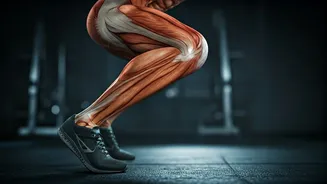
Every exercise you perform has two main phases. There’s the concentric phase, where the muscle shortens to create movement—think of pushing up from the bottom of a squat. [15] Then there’s the eccentric phase, where the muscle lengthens under tension
to control the movement—the slow, controlled descent into the squat. [15, 25] A negative eccentric squat simply shifts the focus to this lowering phase, making it deliberate and significantly slower than the upward push. [5, 26] Instead of just dropping into the squat, you are actively resisting gravity on the way down, which is why it's sometimes called "negative work." [1, 10]
Why Slower Can Be Stronger
Slowing down might seem counterintuitive, but the science supports it for building both strength and muscle mass. During an eccentric contraction, your muscles can actually handle more load and generate more force—up to 50% more than during the concentric (lifting) phase. [8, 18, 21] This increased mechanical tension creates more micro-tears in the muscle fibers. [2, 14] While that sounds like a bad thing, it's this very process of damage and repair that signals your body to rebuild the muscles bigger and stronger. [1] This focus on "time under tension" can be a powerful stimulus for muscle growth, or hypertrophy. [5, 16]
A Safer Way to Build Your Legs
Beyond muscle growth, one of the biggest benefits of eccentric training is its role in joint health and injury prevention. [4, 22] Fast, uncontrolled movements can put a lot of stress on your knees and lower back. By slowing the squat down, you improve your control, stability, and movement patterns. [24] This controlled loading helps to strengthen not just the muscles but also the tendons and connective tissues, making your joints more resilient. [3, 20] In fact, eccentric exercises are a cornerstone of physical therapy and rehabilitation for conditions like tendinopathies precisely because they build tissue strength in a safe, controlled manner. [10, 22]
How It Changes Your Leg Workout
Incorporating eccentric squats doesn't mean you have to abandon traditional training, but it does change the focus. Instead of chasing a high number of fast reps, the goal becomes quality and control. Since eccentric movements are more demanding and can create more muscle soreness (known as DOMS) initially, you may find you need fewer reps to feel the effects. [12, 22] A workout might shift from three sets of 12 fast squats to four sets of six slow, deliberate eccentric squats. This approach is less about cardiovascular fatigue and more about deep muscular work, helping you break through strength plateaus without simply adding more weight. [9, 11]
How to Perform a Basic Eccentric Squat
You can start with just your body weight to master the form. Stand with your feet about shoulder-width apart, toes pointing slightly outwards. [1] Keep your chest up and core braced. Begin to lower yourself by pushing your hips back, as if sitting in a chair. [7] The key is the tempo: take a slow 3 to 5 seconds to complete the entire downward motion. [26] Once your thighs are parallel to the floor, or as low as you can comfortably go, pause for a moment. Then, return to the starting position at a normal, faster pace—about one second. [3] That entire sequence is one repetition.
Ways to Progress and Add Challenge
Once you're comfortable with the bodyweight version, you can add resistance. A simple way is to hold a dumbbell or kettlebell in front of your chest for a goblet squat, maintaining the same slow-down, fast-up tempo. [12] For more advanced lifters, this can be applied to barbell back squats, but it's wise to reduce the weight you'd normally use. [12] Another way to progress is to try a single-leg variation, where you lower down slowly on one leg and then use both legs to stand back up. [7] This is an excellent way to build unilateral strength and stability.