






A 'First Light' Moment for Space
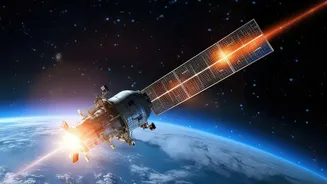
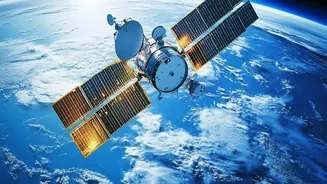
The groundbreaking technology, part of an experiment called Deep Space Optical Communications (DSOC), is being tested aboard NASA's Psyche spacecraft. In a landmark test, the system beamed a 15-second, ultra-high-definition video from 19 million miles
away back to Earth. The video—whimsically featuring a cat named Taters chasing a laser pointer—was transmitted at a maximum rate of 267 megabits per second (Mbps), a speed comparable to many home broadband connections. This successful demonstration, led by NASA's Jet Propulsion Laboratory (JPL), proved that laser communications can provide a massive data pipeline from the far reaches of our solar system.
How Lasers Outpace Radio Waves
For decades, space missions have relied on radio frequency (RF) systems to send and receive data. While reliable, RF technology is like trying to send a feature film through a dial-up modem; the bandwidth is extremely limited. Laser, or optical, communication is the upgrade to fiber-optic speed. It uses invisible, near-infrared light, which has a much higher frequency than radio waves. This allows it to pack data into significantly tighter waves, meaning ground stations can receive vastly more information in a single transmission. It isn't that the signal travels faster—both radio and light move at the speed of light—but that each 'packet' of information is exponentially larger. NASA projects this method can transmit 10 to 100 times more data than the best current radio systems.
The '100 Times Faster' Breakthrough
The headline-grabbing claim of being one hundred times faster refers to the potential increase in data throughput compared to conventional RF systems used on deep space missions. For example, the Mars Reconnaissance Orbiter's advanced radio system requires over seven hours to transmit all the data from its onboard recorder. The DSOC experiment, even at vast distances, has demonstrated capabilities far beyond this. It achieved 267 Mbps at 19 million miles and maintained a rate of 8.3 Mbps from 249 million miles away—a distance comparable to Mars' farthest point from Earth. This sustained performance confirms that optical communications can transform how we explore, enabling us to get more science, high-definition images, and video from our robotic and, eventually, human explorers.
Unlocking the Future of Exploration
This technological leap is more than just about faster downloads; it's a fundamental enabler for the next era of space exploration. Future missions to the Moon and Mars will generate unprecedented volumes of data, from high-resolution geological maps to 4K video feeds from astronauts. This technology will allow for real-time guidance of rovers, streaming of complex scientific instrument data, and providing a robust communication link for humans living and working on another planet. With this capability, NASA can support more complex experiments and ensure a high-bandwidth connection for the first astronauts who travel to Mars, a crucial step in making humanity a multi-planetary species.
Challenges and the Path Forward
Transmitting data via laser across millions of miles is not without its challenges. The system requires pointing a laser beam with incredible precision—a deviation of a fraction of a degree could cause the beam to miss Earth entirely. The DSOC experiment on the Psyche mission, which concluded its final tests in September 2025 after two years of operations, was designed to overcome these hurdles. Having exceeded all its goals, the demonstration has provided a wealth of data that will inform the design of future operational systems. The next step is to integrate this technology into upcoming missions, like Artemis II, which will carry the first astronauts to use laser communications in space, heralding a new age of cosmic connectivity.